Categories
Founder Advice

Building your pre-seed pitch deck? Here’s what goes inside

Pre-seed founders have to show a competitive edge. We dismantle the science behind building a successful pre-seed pitch deck and the make-or-break sections that go inside.
Justin Izzo headshot
Justin IzzoResearch Lead, Dropbox DocSend
February 24, 2026
successful pre-seed pitch deck

Updated February 24, 2026

Originally published March 2, 2022

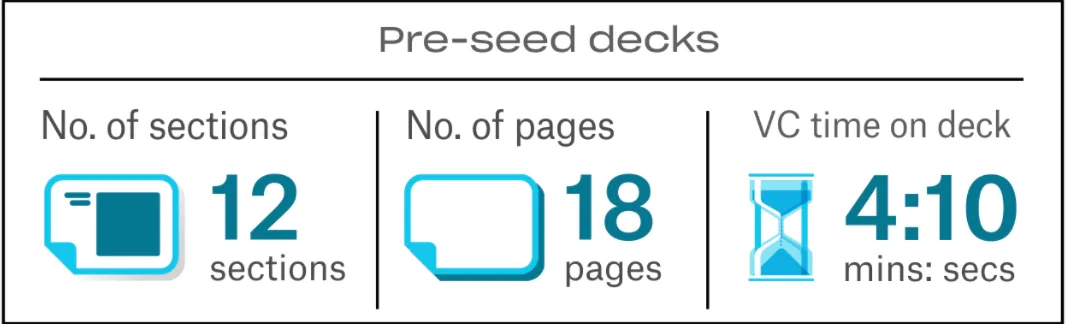
Pre-seed fundraising has evolved dramatically. In 2026's competitive landscape, investors are more selective than ever, spending an average of 4 minutes and 10 seconds evaluating each pitch deck before deciding whether to take a meeting. With thousands of decks crossing their desks annually, founders need every advantage to stand out.

The difference between a funded startup and a passed-over opportunity often comes down to how effectively you structure and present your deck. In this comprehensive guide, we'll break down exactly what goes into a successful pre-seed pitch deck, backed by data from thousands of fundraising rounds analyzed through DocSend.

Whether you're a first-time founder or building your next venture, this guide will show you the 12 make-or-break sections that determine funding success, and how long VCs actually spend on each one.

What is the purpose of a pre-seed pitch deck? (And why it matters more than ever)

A pre-seed pitch deck is your first impression, a strategic document designed to convince potential investors to take meetings with you. It's not just a presentation; it's your company's narrative distilled into 18 pages of compelling storytelling backed by data.

In today's market, where AI-powered companies are raising at unprecedented rates and traditional sectors are being disrupted faster than ever, your pitch deck needs to accomplish three critical goals:

  1. Capture attention immediately (you have seconds, not minutes)

  2. Demonstrate product readiness (even at the earliest stages)

  3. Show competitive differentiation (explain why you, why now, why this approach)

"If it was not for DocSend, we wouldn't have been able to complete our pre-seed raise in such a small time frame. Using specific links to track document analytics helped us focus our energy on reaching back out to the right investors who were actually interested." - Alex Simon, Founder at Elude

The 2026 pre-seed fundraising landscape: what’s changed

Before diving into deck structure, it's important to understand the current fundraising environment:

Key trends shaping pre-seed raises in 2026:

  • AI-native expectations: Even non-AI companies are expected to demonstrate how they're leveraging AI for competitive advantage

  • Product-led validation: Investors want to see evidence of product-market fit earlier than ever—waitlists, beta users, letters of intent

  • Capital efficiency focus: With the market correction of 2023-2024 still fresh, VCs prioritize founders who can demonstrate lean, strategic spending

  • Remote-first due diligence: Virtual meetings are now standard, making your deck analytics and virtual data room strategy critical

  • Faster decision cycles: Competitive deals move faster, but investors are also quicker to pass when decks don't meet their criteria

How much time do investors spend on pre-seed decks?

Our research analyzing thousands of pitch decks reveals that VCs spend an average of 4 minutes and 10 seconds evaluating pre-seed pitch decks. While this might seem brief, it's actually substantial when you consider:

  • VCs receive 100+ decks per week on average

  • Only 1-2% of decks lead to meetings

  • Partners must review deals across multiple sectors simultaneously

preseed-decks.png

The Reality: Your pitch deck isn't just competing for attention—it's fighting for survival in a crowded market. This is why strategic structure, clear messaging, and compelling visuals matter so much.

Understanding where investors spend their time helps you prioritize your deck sections strategically. (Spoiler: They spend the most time on your business model and product sections—we'll explain why below.)

Related: How to create an investor strategy for your pre-seed fundraise

The anatomy of a winning pre-seed pitch deck: 12 essential sections

Based on analysis of successful pre-seed raises, the optimal deck structure contains 18 pages organized into 12 clearly defined sections. This structure has proven to generate the highest engagement and conversion rates.

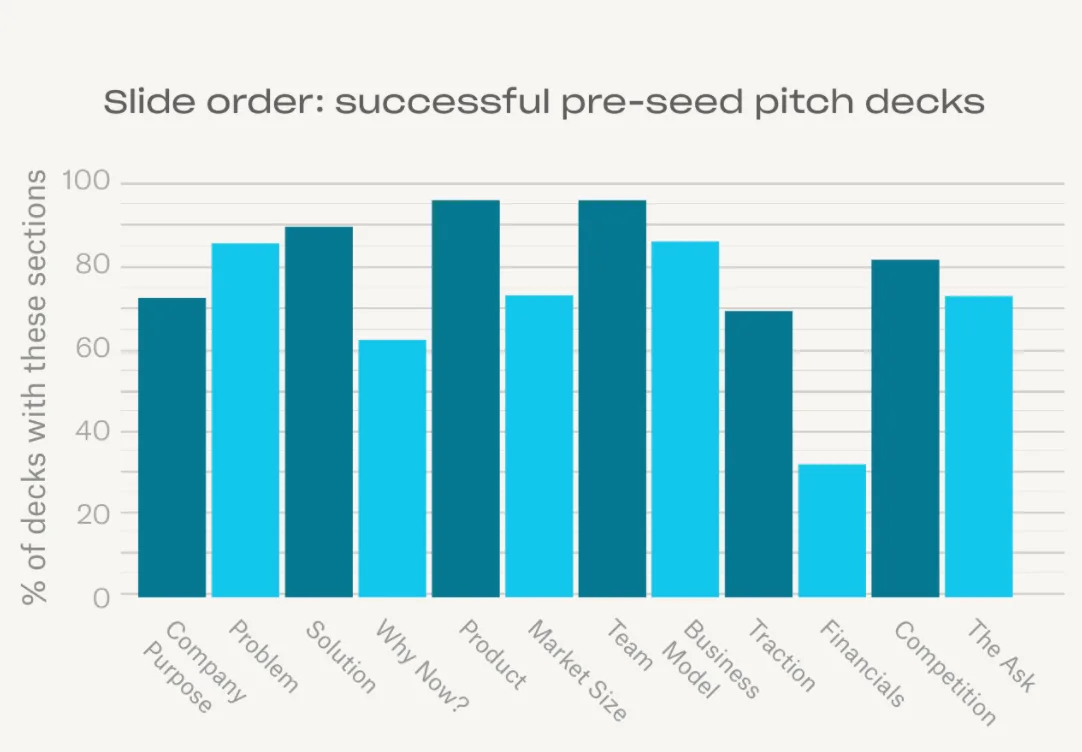
slide-order.png

Here's the exact structure that works, including how long VCs spend on each section:

We’ve found that the best way to capture VC attention is by building an 18-page pitch deck with the following sections (and in the outlined order!).

Below, we break down each of these sections, define their purposes, and offer do’s and don’ts for crafting messaging that captivates potential investors.

Section 1: Company purpose

What It Is: A clear, memorable one-sentence explanation of your company's mission and value proposition.

Why It Matters: This is your hook. If investors don't understand your purpose in the first 30 seconds, they may not continue reading.

DO:

  • Craft a single, powerful sentence that captures your company's essence

  • Make it memorable and repeatable

  • Test it on non-technical people—if they don't get it, refine it

  • Focus on the transformation you're creating, not just the product

DON'T:

  • Write a grandiose, jargon-filled mission statement

  • Try to explain everything about your company in one slide

  • Use buzzwords without substance ("revolutionary," "disruptive" without context)

  • Make it about you—make it about the change you're driving

Example Structure:

"[Company Name] enables [target customer] to [achieve specific outcome] by [unique approach]."

Industry Benchmarks:

  • Average section length: 1.3 pages

  • Time VCs spend here: 33 seconds

  • Target length: 1 page

Pro Tip: In 2026, investors appreciate specificity. Instead of "We're building the future of work," try "We enable remote teams to collaborate 3x faster through AI-powered async communication."

Section 2: Problem (1-2 Pages)

What It Is: A clear definition of the specific problem your company solves, including its scope and impact.

Why It Matters: Investors need to believe the problem is significant, urgent, and affects a large enough market to warrant venture investment.

DO:

  • Define the problem at its broadest level using simple language

  • Quantify the problem's impact with statistics or market data

  • Make it relatable—any VC should immediately grasp why this matters

  • Connect it to a personal story or real customer pain point when possible

  • Address why existing solutions fall short

DON'T:

  • Assume the problem is obvious—spell it out clearly

  • Get too technical or industry-specific in your language

  • Present multiple unrelated problems (focus on ONE core issue)

  • Skip the "why this matters" context


2026 Context: With AI capabilities expanding rapidly, make sure your problem statement addresses why human intervention, workflow improvement, or your specific approach is still necessary. Don't present problems that AI has already solved.

Industry Benchmarks:

  • Average section length: 2.15 pages

  • Time VCs spend here: 39 seconds

  • Target length: 1-2 pages

Framework to Use:

  1. Current state: "Today, [target users] struggle with [specific problem]"

  2. Impact:"This costs them[time/money/opportunity]"

  3. Why it persists: "Existing solutions fail because [gap in market]"

Related: How to nail the 3 most scrutinized sections in your pre-seed pitch deck

Section 3: Solution (1-2 Pages)

What It Is: Your unique approach to solving the problem defined in the previous section.

Why It Matters: This is where you differentiate yourself. Investors need to understand not just WHAT you're building, but WHY your approach is uniquely positioned to succeed.

DO:

  • Present a clear, strategic approach that directly addresses your problem statement

  • Highlight what makes your solution unique or 10x better than alternatives

  • Keep the solution at the same level of breadth as your problem (don't jump into features)

  • Explain your core insight or "unfair advantage"

  • Address the "why now" factor if relevant to your solution approach

DON'T:

  • Dive into technical product details (save that for the Product section)

  • Present a solution that only partially addresses your problem

  • Claim you have "no competition" (it signals lack of market research)

  • Use vague language like "we leverage cutting-edge technology"

2026 Best Practices:

  • If using AI/ML, be specific about what problem it solves (not just "AI-powered")

  • Address data privacy/security if relevant to your solution

  • Mention platform/infrastructure choices only if they're differentiating factors

Industry Benchmarks:

  • Average section length: 1.5 pages

  • Time VCs spend here: 27 seconds

  • Target length: 1-2 pages

Alignment Check:

Your solution slide should mirror your problem slide in structure. If you defined 3 aspects of the problem, show how your solution addresses all 3.

Section 4: Why Now? (1 Page - Optional)

What It Is: An explanation of current market conditions, technological shifts, or societal changes that create a unique opportunity for your solution.

Why It Matters: Timing is everything in venture capital. This section explains why your company couldn't have succeeded five years ago, and might not succeed five years from now.

DO:

  • Point to specific market shifts, technology enablers, or regulatory changes

  • Reference recent events that validate your thesis

  • Connect trends directly to your solution's viability

  • Use data to support your timing argument

  • Make it feel urgent without being alarmist

DON'T:

  • Include this section if there isn't genuine timeliness to your solution

  • Reference trends that have been discussed for years without explanation

  • Rely solely on COVID-19 as your "why now" (it's 2026—move beyond pandemic references)

  • List generic trends without connecting them to your specific opportunity

2026 Relevant Triggers:

  • AI Capability Explosion: GPT-4 and beyond enabling new applications

  • Regulatory Changes: New data privacy laws, AI regulations, industry-specific legislation

  • Market Corrections: Post-2023 environment creating new needs

  • Climate Urgency: Sustainability requirements becoming non-negotiable

  • Remote Work Permanence: Distributed teams creating new infrastructure needs

  • Web3/Blockchain Maturation: Technology finally ready for mainstream adoption

Industry Benchmarks:

  • Average section length: 1.5 pages

  • Time VCs spend here: 38 seconds

  • Target length: 1 page

When to Skip This Section:

If your timing is not particularly unique, skip this section. It's better to have a strong, focused deck without it than to force a weak "why now" argument.

Section 5: Product (3-4 Pages) HIGHLY SCRUTINIZED

What It Is: Visual demonstration of your product, showing features, user experience, and current state of development.

Why It Matters: This is one of the most scrutinized sections in your entire deck. Investors spend 77 seconds here—nearly twice as long as most other sections. They need to see that you can actually build what you're proposing.

DO:

  • Go as deep as possible into product readiness, even if you're pre-GA

  • Include multiple visual formats: wireframes, screenshots, videos, Figma mockups, feature GIFs

  • Show actual product if it exists; show detailed prototypes if it doesn't

  • Add contextual headlines explaining each feature's value

  • Demonstrate user flow and experience

  • Include testimonials or early user feedback if available

  • Show your product roadmap or near-term development plans

  • For AI products: Show actual outputs, not just interface mockups

DON'T:

  • Take a light-handed approach—this is not the place to be vague

  • Show only a logo or landing page design

  • Present generic UI without explaining functionality

  • Skip this section because you're "too early" (you can show prototypes)

  • Use placeholder text or "Lorem ipsum" in mockups

2026 Product Demonstration Standards:

  • For Pre-Product Companies: High-fidelity Figma prototypes, detailed wireframes, user flow diagrams

  • For Beta Products: Screenshots of real interface, demo videos, early user testimonials

  • For Launched Products: Usage metrics, feature adoption data, user retention stats

  • For AI Products: Show real model outputs, explain training approach, address accuracy/reliability

Industry Benchmarks:

  • Average section length: 3.3 pages

  • Time VCs spend here: 77 seconds (LONGEST!)

  • Target length: 3-4 pages

Structure Recommendation:

  • Page 1: Product overview/main dashboard

  • Page 2: Core feature #1 with explanation

  • Page 3: Core feature #2 with explanation

  • Page 4: Product roadmap or additional features

Pro Tip: Link to a product demo video or live demo environment using DocSend's video embedding capabilities. This dramatically increases engagement.

Section 6: Market Size (1 Page)

What It Is: Analysis of your total addressable market (TAM), serviceable addressable market (SAM), and serviceable obtainable market (SOM), along with growth projections.

Why It Matters: Investors need to know your market is large enough to support a venture-scale outcome (typically $1B+ potential).

DO:

  • Show all three market calculations: TAM, SAM, and SOM

  • Use credible sources for market data (Gartner, IDC, CB Insights, etc.)

  • Demonstrate market growth trajectory with year-over-year projections

  • Connect your target customer profile to specific market segments

  • Show how your pricing model maps to market capture

  • Address both current market size and future growth potential

DON'T:

  • Understate your market size to seem"realistic" (VCs want big markets)

  • Use only top-down market sizing without bottom-up validation

  • Present a TAM so large it's implausible ($1 trillion markets rarely exist)

  • Forget to show your path from SOM to SAM over time

  • Use outdated market research (nothing older than 2024)

2026 Market Sizing Best Practices:

  • Bottom-Up Method: [number of potential customers] × [price per customer] × [expected penetration rate]

  • Top-Down Method: [existing market size] × [your segment %] × [adoption rate]

  • Value Theory Method: [value created per customer] × [number of potential customers]

Industry Benchmarks:

  • Average section length: 1.7 pages

  • Time VCs spend here: 39 seconds

  • Target length: 1 page

Section 7: Team (1-2 Pages)

What It Is: Introduction to your founding team, highlighting backgrounds, expertise, and why you're uniquely qualified to build this company.

Why It Matters: At the pre-seed stage, investors often invest more in the team than the idea. They need confidence that you can execute, adapt, and scale.

DO:

  • Lead with your strongest founder/team member

  • Highlight relevant experience that maps to your business

  • Show complementary skill sets across the founding team

  • Include brief, punchy bios (2-3 sentences max per person)

  • Add professional headshots for each founder

  • Mention notable advisors, investors, or key hires, if relevant

  • Connect team expertise to the problem you're solving

  • Highlight any previous exits, notable companies, or domain expertise

DON'T:

  • List every job title from the past 20 years

  • Include team members who aren't founders or critical to early execution

  • Write overly long bios that feel like LinkedIn profiles

  • Forget to explain WHY this specific team can win

  • Skip addressing gaps in expertise (you can note planned hires)

2026 Team Dynamics:

  • Remote-First Teams: Note if team is distributed and how you maintain velocity

  • Technical + Business Balance: Show you have both sides covered

  • AI/Technical Expertise: For AI companies, highlight ML/data science credentials

  • Diverse Perspectives: Investors increasingly value diverse founding teams

Industry Benchmarks:

  • Average section length: 1.5 pages

  • Time VCs spend here: 46 seconds

  • Target length: 1-2 pages

Addressing Team Gaps:

If you're missing critical expertise (e.g., technical co-founder, go-to-market leader), acknowledge it and explain your plan to fill the gap with early hires or advisors.

Section 8: Business Model (2-3 Pages) MOST SCRUTINIZED

What It Is: Your monetization strategy, pricing structure, customer acquisition approach, and path to profitability.

Why It Matters: This is THE most scrutinized section in your entire deck. Investors spend 83 seconds here—longer than any other section. They're evaluating whether your company can actually make money and scale.

DO:

  • Clearly articulate your revenue model (SaaS, marketplace, transaction fees, etc.)

  • Show specific pricing tiers and target customer segments

  • Explain your unit economics: CAC (Customer Acquisition Cost) and LTV (Lifetime Value)

  • Include a path to profitability, even if it's 3-5 years out

  • Show multiple revenue streams if applicable

  • Demonstrate how pricing scales with value delivery

  • Address your go-to-market strategy

  • Show early validation of pricing willingness

DON'T:

  • Present vague "we'll figure out monetization later" approaches

  • Show only theoretical pricing without market validation

  • Ignore customer acquisition costs

  • Present overly complex pricing that's hard to understand

  • Assume "we'll make it up in volume" without supporting data

  • Skip the business model because you're "too early”

2026 Business Model Trends:

  • Usage-Based Pricing: Consumption-based models gaining traction (vs. seat-based)

  • PLG (Product-Led Growth): Free tiers driving organic adoption

  • Hybrid Models: Combining subscription with usage/transaction fees

  • AI Cost Considerations: For AI companies, show GPU/compute cost economics

  • Marketplace Dynamics: Clear take rate and supply/demand balance

Industry Benchmarks:

  • Average section length: 2.8 pages

  • Time VCs spend here: 83 seconds (LONGEST!)

  • Target length: 2-3 pages

Key Metrics to Include:

  • Pricing: What you charge and why

  • CAC: Cost to acquire a customer

  • LTV: Lifetime value of a customer

  • LTV:CAC Ratio: Should be 3:1 or better at scale

  • Gross Margin: Revenue minus cost of goods sold

  • Payback Period:Time to recover CAC (target: <12 months)

Structure Recommendation:

  • Page 1: Revenue model overview and pricing structure

  • Page 2: Unit economics (CAC, LTV, margins)

  • Page 3: Go-to-market strategy and growth model

Related: Understanding SaaS metrics that matter to investors

Section 9: Traction (1-4 Pages)

What It Is: Evidence of market validation, customer adoption, revenue, partnerships, or other proof points that de-risk your venture.

Why It Matters: Traction proves that your solution resonates with real customers. Even at pre-seed, investors want to see early validation signals.

DO:

  • Show ANY traction you have, no matter how early-stage

  • Include metrics that matter: users, revenue, growth rate, engagement

  • Present letters of intent (LOIs), pilot customers, or beta waitlists

  • Share customer testimonials or quotes

  • Show week-over-week or month-over-month growth trends

  • Highlight partnerships, press coverage, or awards

  • Demonstrate product-market fit signals

  • Show retention/engagement metrics if available

DON'T:

  • Skip this section because you think you're "too early"

  • Present vanity metrics without context (social media followers, website visits)

  • Show declining or flat metrics without explanation

  • Cherry-pick data to hide problems

  • Present outdated traction (keep this current)

What Counts as Pre-Seed Traction:

  • 10+ LOIs from potential customers

  • Waitlist of 100+ interested users

  • $10K+ in pre-revenue commitments

  • Pilot programs with 3-5 customers

  • Strong beta feedback with specific quotes

  • Partnership agreements with relevant companies

  • Product engagement metrics (DAU/MAU, session length)

  • Early revenue (even if it's $1K MRR)

Industry Benchmarks:

  • Average section length: 2.3 pages

  • Time VCs spend here: 37 seconds

  • Target length: 1-4 pages (varies by traction level)

2026 Traction Expectations: Even at pre-seed, investors expect to see SOME validation. The bar has risen significantly:

  • No-Code/Low-Code: Build an MVP faster and show usage

  • Beta Programs: Recruit early users via communities

  • Design Partners: Engage customers in development

  • Social Proof: Build in public and demonstrate demand

Visualization Tips:

  • Use charts to show growth trends

  • Include screenshots of customer testimonials

  • Show retention curves or cohort analysis if you have the data

  • Highlight your "hockey stick" moment if you're in growth phase

Section 10: Financials (1-2 Pages - Optional)

What It Is: Historical or projected financial data showing revenue, expenses, burn rate, and runway.

Why It Matters: While optional at pre-seed, this section can demonstrate financial discipline and realistic projections if included properly.

DO:

  • Show realistic, bottoms-up financial projections for the next 18-24 months

  • Include current burn rate and runway

  • Demonstrate how you've managed capital to date (if you've raised before)

  • Show the relationship between spending and growth/traction

  • Break down spending categories (engineering, GTM, operations)

  • Project major hiring milestones

DON'T:

  • Include this section if you can cover spending in your fundraising ask

  • Show hockey-stick revenue projections without supporting evidence

  • Present 5-year projections (not credible at this stage)

  • Ignore burn rate or runway

  • Show financials that don't align with your business model section

When to Include This Section:

  • You've already raised a small angel/friends & family round and have financial history

  • You have early revenue and can show trajectory

  • You need to explain your burn rate or capital efficiency

Industry Benchmarks:

  • Average section length: 1.4 pages

  • Time VCs spend here: 40 seconds

  • Target length: 1-2 pages (if included)

Section 11: Competition (1 Page)

What It Is: Analysis of your competitive landscape, including direct competitors, adjacent solutions, and your differentiation.

Why It Matters: Investors spend 55 seconds on this section—substantial time validating that you understand your market and can articulate why you're different.

DO:

  • Identify 3-5 realistic competitors at similar stages or slightly ahead

  • Use a competitive matrix or positioning chart to show differentiation

  • Focus on companies that are actually competitive threats

  • Explain your differentiation clearly (technology, business model, market approach)

  • Acknowledge competitors' strengths honestly

  • Show why customers would choose you over alternatives

  • Include indirect competition or status quo alternatives

DON'T:

  • Claim you have "no competition" (major red flag)

  • Only compare yourself to large enterprise companies (Google, Microsoft, etc.)

  • List every tangentially related company

  • Trash-talk competitors (unprofessional)

  • Show a competitive matrix where you're "winning" on every dimension (not credible)

  • Ignore the biggest competitor: people doing nothing / status quo

2026 Competitive Landscape:

  • AI Enables New Competition: Companies can build competitive solutions faster with AI

  • Open Source Alternatives: Address if open-source tools can replace your product

  • Incumbent Product Expansion: Established players adding features to existing products

  • "Do Nothing" Option: Often the biggest competitor at early stage

Industry Benchmarks:

  • Average section length: 1.3 pages

  • Time VCs spend here: 55 seconds

  • Target length: 1 page


Differentiation Framework:

Answer these questions:

  1. What do you do differently? (approach, technology, business model)

  2. Why does it matter? (customer value, outcomes, economics)

  3. Why can't they copy you? (defensibility, network effects, IP, team advantages)

Related: How to structure a pre-seed pitch deck beyond the minimum viable PowerPoint

Section 12: Fundraising Ask (1 Page)

What It Is: The specific amount you're raising, how you'll use the capital, and what milestones you'll achieve with it.

Why It Matters: This is your call-to-action. Investors need to know exactly what you're asking for and why it makes sense.

DO:

  • State your exact fundraising target (e.g., "Raising $2M pre-seed")

  • Break down capital allocation by category with percentages

  • Show what milestones you'll hit with this capital

  • Include your timeline to next raise (typically 18-24 months runway)

  • Specify if this round is open, how much is committed, and your target close date

  • Mention your fundraising strategy (lead investor + angels vs. party round)

  • Include desired investor profile or support you're seeking

DON'T:

  • Be vague about the amount ("Raising $1-3M")

  • Show unrealistic spending allocations (e.g., 80% to engineering)

  • Forget to mention runway or timeline

  • Present overly generic use of funds ("working capital")

  • Skip the "why this amount" rationale

2026 Pre-Seed Round Sizes:

Based on current market conditions:

  • Typical Range: $500K - $3M

  • Emerging Trend: Higher pre-seed rounds ($2-3M) for capital-intensive businesses (AI, hardware)

  • Standard Valuation: $8-15M post-money cap

  • Dilution: Aim for 10-20% equity given up at pre-seed

Industry Benchmarks:

  • Average section length: 1.2 pages

  • Time VCs spend here: 40 seconds

  • Target length: 1 page

Closing Statement Example:

"We're raising $2M in a pre-seed round to build our founding team, achieve product-market fit, and scale to $500K ARR—positioning us for a strong Series A in 24 months. We've already committed $600K from angels and are seeking a lead investor to close the round by [date]."

Advanced Tips: Making Your Pitch Deck Stand Out in 2026

Now that you understand the essential sections, here are advanced strategies to make your deck truly exceptional:

1. Optimize for Virtual Presentation

Most pre-seed meetings happen via Zoom in 2026. Design your deck accordingly:

  • Use large, readable fonts (minimum 24pt for body text)

  • Keep slides visually simple for screen sharing

  • Embed short video demos that can play during presentations

  • Create a "demo environment" link for live product walkthroughs

  • Include slide notes for context (visible when shared via DocSend)

2. Leverage Data Analytics

Use DocSend or similar tools to:

  • Track which VCs actually open and read your deck

  • See which sections they spend the most time on

  • Identify where they stop reading (signals where to improve)

  • Follow up strategically based on engagement data

  • A/B test different versions of your deck

3. Create Supporting Materials

Beyond your main deck, prepare:

  • One-Pager: Condensed version for initial outreach

  • Data Room: Detailed financials, contracts, technical docs

  • Demo Video: 2-minute product walkthrough

  • FAQ Document: Address common investor questions

  • Metrics Dashboard: Real-time traction updates

4. Storytelling Techniques

  • Open with a Hook: Start with a compelling stat or customer story

  • Use Founder's Journey: Connect your personal story to the problem

  • Show Don't Tell: Visuals > Text. Screenshots > Descriptions.

  • Create Narrative Flow: Each slide should naturally lead to the next

  • End with Urgency: Why now? Why this round? Why you?

5. Design Best Practices

  • Use a professional template

  • Stick to 2-3 brand colors maximum

  • Use consistent fonts and sizing throughout

  • Include whitespace—don't cram slides with information

  • Professional photography for team photos

  • High-quality product screenshots (no lorem ipsum!)

6. AI-Era Considerations

For companies building in or around AI:

  • Be Specific About AI Use: Don't just say "AI-powered"—explain what models, what technique, what value

  • Address AI Ethics: Data privacy, bias mitigation, responsible AI practices

  • Show AI Economics: Cost to serve, model training expenses, scalability

  • Demonstrate AI Advantage: Why AI makes your solution 10x better, not just incrementally better

Common Pre-Seed Pitch Deck Mistakes to Avoid

Even experienced founders make these errors. Avoid them at all costs:

Mistake #1: Too Long or Too Short

  • Problem: Decks that are 40+ slides or under 10 slides both signal problems

  • Solution: Stick to the 18-page framework. More than 20 pages exceeds attention span; fewer than 15 suggests lack of substance

Mistake #2: Burying the Lead

  • Problem: Leading with company history, long-winded explanations, or context before getting to the point

  • Solution: Front-load your most compelling information. Investor attention drops off dramatically after slide 5

Mistake #3: Weak Product Section

  • Problem: Vague mockups, generic UI, or "coming soon" placeholders

  • Solution: Show your product in as much detail as possible. This is where VCs spend the most time (77 seconds!)

Mistake #4: Unrealistic Business Models

  • Problem: No clear monetization,"we'll figure it out," or assuming unrealistic conversion rates

  • Solution: Run the numbers bottom-up. Show you understand unit economics even if they're early/theoretical

Mistake #5: Ignoring Competition

  • Problem: Claiming "no competitors" or only comparing to incumbents

  • Solution: Show you've done market research. Acknowledge both direct and indirect competition

Mistake #6: Team-Market Mismatch

  • Problem: Team section that doesn't connect expertise to the problem being solved

  • Solution: Explicitly explain why THIS team is uniquely qualified to solve THIS problem

Mistake #7: No Clear Ask

  • Problem: Vague fundraising requests or missing the "what happens next" clarity

  • Solution: Be specific: amount, timeline, how you'll use it, milestones you'll hit

Mistake #8: Outdated Information

  • Problem: Using old data, expired traction metrics, or outdated market information

  • Solution: Update your deck at least monthly with latest metrics and market conditions

Pre-Seed Pitch Deck Checklist: Launch-Ready Validation

Before sending your deck to investors, verify each of these items:

Content Checklist:

  • 18 pages (±2 pages acceptable)

  • All 12 sections included (or intentionally omitted with good reason)

  • Clear one-sentence company purpose

  • Specific problem statement with impact quantified

  • Differentiated solution that directly addresses the problem

  • 3-4 pages of detailed product visuals (screenshots, prototypes, demos)

  • Market size with TAM/SAM/SOM breakdown

  • Team section with relevant experience highlighted

  • Detailed business model with pricing and unit economics

  • Traction metrics (even if early-stage)

  • Realistic competition analysis

  • Specific fundraising ask with capital allocation

Design Checklist:

  • Professional, consistent design throughout

  • Large, readable fonts (24pt+ for body text)

  • High-quality images and screenshots

  • Consistent color schemes (2-3 colors max)

  • Adequate whitespace on each slide

  • No spelling or grammar errors

  • Page numbers included

  • Company logo on each slide

  • Contact information on final slide

Technical Checklist:

  • PDF format (not PowerPoint or Google Slides links)

  • File size under 10MB for easy sharing

  • Embedded fonts to ensure consistent rendering

  • High-resolution images (not pixelated)

  • Hyperlinks tested and working

  • Shared via DocSend or similar for tracking analytics

  • NDA or viewing restrictions set (if applicable)

  • Mobile-friendly formatting tested

Strategic Checklist:

  • Narrative flows logically from slide to slide

  • Each slide can stand alone if needed

  • Deck can be presented in 10-12 minutes

  • You can defend every claim and number

  • Deck differentiated from competitors' decks

  • Tested with advisors or friendly VCs

  • Custom versions prepared for different investor types

  • Support materials ready (data room, one-pager, demo)

The DocSend Advantage: Using Analytics to Optimize Your Raise

One of the biggest mistakes founders make is treating their pitch deck like a static document. In reality, your deck should evolve based on investor feedback and engagement data.

Track These Key Metrics with DocSend:

  • Open Rate: What % of VCs actually open your deck?

  • Time Spent: How long do they spend reviewing it?

  • Section Engagement: Which sections get the most attention?

  • Drop-Off Points: Where do investors stop reading?

  • Return Visits: Who comes back multiple times? (strong signal!)

  • Forward Rate: Are investors sharing your deck internally?

How to Use This Data:

  • Low Open Rate? → Your subject line or outreach message needs work

  • Short Time Spent → Your opening slides aren't hooking readers

  • Drop-Off at Specific Section? → That section needs revision or clarification

  • High Return Visits? → Indicates strong interest—follow up immediately

  • Internal Forwarding? → Sign of partner buy-in—prepare for next-stage meetings

"Using specific links to track document analytics helped us focus our energy on reaching back out to the right investors who were actually interested. This was a game-changer for our pre-seed raise." - Alex Simon, Founder at Elude

Related: Virtual data rooms for startups

What Happens After You Send Your Deck?

Understanding the VC decision-making process helps you follow up strategically:

Typical VC Evaluation Timeline:

Week 1: Initial Review

  • Partner receives and reviews your deck (4 min 10 sec on average)

  • Decision: Pass, request meeting, or forward to team

Week 2-3: First Meeting

  • 30-45 minute Zoom call or in-person meeting

  • Present your pitch, answer questions, gauge interest

  • VC internal discussion about moving forward

Week 3-4: Diligence Begins

  • Reference calls with customers, partners, advisors

  • Product deep-dive with technical team

  • Market research and competitive analysis

  • Review of data room materials

Week 4-6: Partner Meeting

  • You present to full partnership

  • Partners vote/discuss investment decision

  • Term sheet issued if approved

Week 6-8: Term Sheet to Close

  • Negotiate terms

  • Legal documentation

  • Background checks, final diligence

  • Wire funds and close

Total Timeline: 6-12 weeks for pre-seed rounds (faster than Series A+)

Follow-Up Best Practices:

After Sending Deck:

  • Wait 3-4 days before following up

  • Send a brief, value-add follow-up (new traction, press, insights)

After First Meeting:

  • Send thank-you email within 24 hours

  • Address any open questions raised in the meeting

  • Provide requested materials immediately

  • Suggest next steps and timeline

If They Pass:

  • Ask for specific feedback

  • Request introductions to other investors

  • Ask to stay in touch for future rounds

  • Learn from the feedback and iterate

Frequently Asked Questions (FAQ)

Q: How long should my pre-seed pitch deck be?

A: The optimal length is 18 pages based on analysis of successful fundraises. You can go slightly under (15-16 pages) or over (19-20 pages), but significantly more or less signals either lack of content or too much detail.

Q: Should I include financial projections at the pre-seed stage?

A: It's optional. Include a financials section if you have revenue history or have raised a prior round. Otherwise, you can include basic spending plans in your fundraising ask section.

Q: What if I don't have any traction yet?

A: Show whatever validation you DO have: customer conversations, LOIs, beta waitlist, design partners, industry expert feedback. Even qualitative traction is better than nothing.

Q: How much should I be raising in my pre-seed round?

A: Typical pre-seed rounds range from $500K to $3M in 2026. The right amount depends on your burn rate and timeline to next milestones. Aim for 18-24 months of runway.

Q: Should I send my deck as a PDF or PowerPoint?

A: Always send as PDF via a secure link (DocSend recommended). PDFs ensure consistent formatting and allow you to track engagement. Never send editable PowerPoint files.

Q: How do I handle competitors who are further along?

A: Acknowledge their traction while highlighting what you do differently—whether it's your approach, target market, business model, or team advantages. Show you've learned from their path.

Q: What's the biggest mistake founders make with pre-seed decks?

A: Weak product sections. VCs spend 77 seconds on your product slides—the longest of any section. Yet, many founders skimp here with vague mockups or "coming soon" placeholders. Show the product!

Q: How often should I update my deck?

A: Update traction metrics monthly, and do a comprehensive refresh every quarter or when something significant changes (new product launch, major customer, pivot).

Q: Should I customize my deck for different investors?

A: Yes! At minimum, research each VC's portfolio and investment thesis. Consider creating variations that emphasize different aspects (technical depth for technical VCs, go-to-market for distribution-focused VCs).

Q: What if my co-founder doesn't have traditional startup experience?

A: Highlight transferable skills, domain expertise, and personal connection to the problem. Inexperience in startups can be offset by deep industry knowledge or technical prowess.

Next Steps: From Deck to Funding

Building your pitch deck is just the beginning. Here's your roadmap to a successful pre-seed raise:

1. Build Your Investor List (Week 1-2)

  • Research 50-100 potential investors

  • Categorize by: stage focus, sector focus, geography, check size

  • Identify warm introduction paths

  • Prioritize "A-list" (dream investors) vs. "B-list" (backup options)

Resource: How to create an investor strategy for your pre-seed fundraise

2. Prepare Your Data Room (Week 2-3)

  • Organize financial statements and projections

  • Compile customer contracts, LOIs, testimonials

  • Prepare technical architecture documentation

  • Ready cap table and prior funding documents

  • Draft FAQ document for common investor questions

Resource: Virtual data rooms for startups

3. Execute Your Outreach (Week 3-8)

  • Send decks via DocSend with tracking enabled

  • Follow up strategically based on engagement data

  • Schedule meetings with interested investors

  • Run a tight process (don't let it drag 6+ months)

  • Create FOMO by showing momentum

4. Master Your Pitch Presentation (Ongoing)

  • Practice your deck 20+ times before first meeting

  • Anticipate tough questions and prepare answers

  • Get comfortable presenting via Zoom

  • Record yourself and watch for improvement areas

  • Test on advisors, other founders, friendly VCs

5. Close Your Round (Week 8-12)

  • Identify your lead investor first (crucial!)

  • Negotiate terms strategically

  • Fill the round with complementary investors

  • Set a hard close date to create urgency

  • Celebrate, then get back to building!

Conclusion: Your Pitch Deck is Your Competitive Advantage

In 2026's increasingly competitive pre-seed environment, your pitch deck isn't just a formality—it's a strategic weapon. The difference between getting funded and getting passed often comes down to how effectively you communicate your vision, demonstrate your progress, and convince investors that you're the team to back.

Remember these key takeaways:

  • Structure Matters: Follow the 18-page, 12-section framework proven to work

  • Product Depth Wins: Spend 3-4 pages showing your product in detail

  • Business Model Clarity: Articulate monetization clearly (VCs spend 83 seconds here)

  • Show Traction Early: Even pre-revenue companies need validation signals

  • Use Data to Optimize: Track engagement and iterate based on investor behavior

  • Make It Visual: Screenshots > descriptions, charts > walls of text

  • Tell a Story: Create narrative flow that's compelling and memorable

Pre-seed fundraising will only grow more sophisticated in the coming years. Founders who invest time in building exceptional pitch decks—and who leverage tools like DocSend to optimize based on data—will have a significant advantage.

Ready to start fundraising? Check out these resources:

About the Author

Justin Izzo headshot

Justin Izzo

Research Lead, Dropbox DocSendJustin Izzo is Research Lead, DocSend at Dropbox. He joined DocSend in 2020 to run startup and venture capital fundraising research. Previously, Justin was a Professor at Brown University and Duke University. He also received his Ph.D. from Duke University.
Experience the best of DocSend free for 14 days
Securely share your documents with real-time control and insights—no matter where you're working.Get Started Free
No credit card required

Subscribe to The Weekly Index for exclusive content