How to take your board presentation from boring to brilliant
Here's how to create an impactful presentation that will impress your board, boost your authority, and drive better decision-making for M&A deals, fundraising, and strategic initiatives.
Updated March 16, 2026
Originally published January 23, 2020
A board presentation is the CEO's or CFO's opportunity to speak directly to the board of directors. It's your chance to get them to understand your vision, to secure buy-in on financial needs and strategic projects—whether that's an M&A transaction, a major capital raise, or a significant operational pivot—and to explain the company's performance in the context of market dynamics.
But you can only accomplish all of that if board members are actually engaged in the presentation you're giving. In 2026, with hybrid and remote board meetings becoming the norm, and with executives managing increasingly complex business environments—from economic uncertainty to regulatory changes—creating a compelling board presentation is more critical than ever.
That's why it's essential to create and present a board presentation that captures the interest of board members and leaves them feeling invested in what's next. For financial services companies, private equity firms, and businesses navigating M&A processes, the stakes are even higher. Your board presentation may be the deciding factor in securing approval for a major deal, fundraising round, or strategic initiative.
Giving a presentation like that requires more than just charisma. Your presentation—from the topics you include to the slides to your speaking skills—needs to be built with the goal of telling a cohesive story. Here's how to nail all three aspects of a compelling board presentation in 2026.
Topics to cover in your board presentation
The first step in giving a brilliant board presentation is to cover the topics that board members actually care about. When you're presenting on an entire quarter or even a year, you can cover an endless number of topics. But you shouldn't present every tiny detail of what the company did or share every single metric you measured.
Instead, your presentation should focus on these seven categories:
1. Most recent performance data and key accomplishments
Within this section, it's important to highlight the metrics that board members understand and care about. Those metrics can vary from one company to the next, but KPIs like monthly recurring revenue (MRR), annual recurring revenue (ARR), customer acquisition cost (CAC), lifetime value (LTV), churn, net revenue retention (NRR), and new signups or customer growth are always a safe bet. These are the meat and potatoes of your company's performance.
For financial services companies and M&A contexts, also consider including:
Assets under management (AUM) growth
Deal pipeline value and velocity
Due diligence completion rates
Transaction close rates
Fund performance metrics
Investor commitments secured
Capital deployed vs. committed capital
2. Contextual analysis and data interpretation
Once you've shared the numbers, it's important to frame and explain them within the context of time (month-over-month changes, year-over-year growth), company goals, your competitors, and broader market conditions. In 2026's volatile economic environment, this context is more important than ever.
Consider questions like:
How do our metrics compare to industry benchmarks?
What external factors (market conditions, regulatory changes, economic headwinds) influenced performance?
How are we performing relative to our strategic plan?
What does this mean for our competitive position?
3. Transparent discussion of challenges and missed targets
If you frame the data around the goals your company has set and you met or exceeded all of them, that's great. But if you missed any pre-set goals, it's critical to address this head-on with transparency and a clear path forward.
Board members appreciate honesty and a proactive problem-solving approach.
Include:
What went wrong and why (with data-backed analysis)
What you've learned from the miss
Your action plan for course correction
Timeline for improvement
Resources needed to get back on track
For M&A and private equity contexts: Be especially transparent about deal delays, valuation gaps, due diligence findings that changed deal terms, or portfolio company underperformance.
4. Strategic initiatives and upcoming projects
Board presentations aren't all about explaining past numbers—they're also your opportunity to set the stage for future projects that require the board's buy-in, strategic input, or financial support.
This is where you present:
Major strategic initiatives (market expansion, new product launches, M&A opportunities)
Capital allocation decisions
Organizational changes or key hires
Technology investments
Risk mitigation strategies
For financial services: Highlight deal pipeline opportunities, new fund launches, regulatory compliance initiatives, or significant portfolio moves that require board approval.
5. Financial outlook and capital requirements
In 2026, with continued economic uncertainty, boards are laser-focused on runway, burn rate, and capital efficiency. Be explicit about:
Current cash position and runway
Operating expenses and efficiency metrics
Capital requirements for the next 6-12 months
Scenario planning (best case, base case, worst case)
Fundraising timeline and strategy (if applicable)
6. Risk assessment and mitigation
Post-pandemic, boards are more attuned to risk than ever. Address:
Key operational risks and mitigation strategies
Regulatory and compliance risks
Cybersecurity and data protection
Market and competitive risks
Talent retention and succession planning
For M&A transactions: Include integration risks, cultural fit concerns, and regulatory approval risks.
7. Areas where you need the board's expertise and support
At the end of the day, the board is there to provide expertise and help you make the company a success. If there are specific areas or projects where you need to lean more heavily on their input, highlight them in your presentation.
Be specific about:
What decisions you need from the board
Where you need their network or connections
What expertise gaps you're trying to fill
How they can help with fundraising, partnerships, or key hires
How to create compelling and useful slides
Once your presentation is built around the right topics, the next step is to ensure your slides are engaging and helpful in terms of driving the presentation forward and keeping board members interested.
Prioritize visual data storytelling
Your board presentation slides should make ample use of visuals, but the key is to choose the right visuals so they add to the presentation instead of muddying the waters. Great visuals to add include:
Visual representations of data:
Charts and graphs that contextualize data around time periods, company goals, and competitors' performance
Trend lines showing growth trajectories
Comparative bar charts for benchmarking
Waterfall charts for revenue or cost breakdowns
Heat maps for geographic or segment performance
For financial services presentations:
Deal pipeline funnels
Portfolio company performance dashboards
Fund performance attribution charts
Capital deployment timelines
Due diligence scorecards
Sample assets that exemplify strategy:
Screenshots of your newly redesigned platform
Examples of marketing campaigns in market
Product mockups or demos
Customer case studies
Competitive positioning maps
Follow the 5/5/5 rule (or better yet, go even lighter)
Adding visuals helps you keep text to a minimum. As a guideline, follow the 5/5/5 rule:
Each line of text should be 5 or fewer words
Each slide should have 5 or fewer lines of text
The deck should have no more than 5 text-heavy slides in a row
In 2026, the trend is moving toward even more visual, less text-heavy presentations.
Consider:
Using one key number or metric per slide with supporting visual
Dedicating slides to charts and graphs only
Creating "billboard" slides with a single powerful statement
Using speaker notes for detailed information rather than cramming it on slides
Remember: The slide deck serves as notes for your presentation—not to encapsulate every single detail. Your words and presence should do the heavy lifting.
Organize slides with narrative flow
With that in mind, the next step is ensuring your slides are organized in a logical way and that they adhere to the agenda you set (and, hopefully, shared with the board ahead of time). The key here is to let the presentation dictate the slides, instead of the other way around.
While it may save you a few minutes to use the same template for each board presentation, it's more effective to treat each slide deck as its own beast. That means being ruthless about the slides you include and deleting any slides that don't advance or support the presentation.
Treat your board presentation as a three-act play—meaning it should have a clear beginning, middle, and end:
Act 1: Where we've been (Past performance)
Executive summary of key wins and challenges
Performance against goals and KPIs
What we learned and how we adapted
Act 2: Where we're going (Future strategy)
Strategic priorities for the next period
Market opportunities and threats
How we plan to win
Act 3: How we'll get there (Execution plan)
Specific initiatives and projects
Timeline and milestones
Resource requirements and asks
How the board can help
Design for accessibility and clarity
In 2026, with hybrid board meetings common, ensure your slides work for:
In-person viewing: Readable from the back of the room
Remote viewing: Clear on small laptop screens
Mobile viewing: Some board members may review on tablets
Accessibility: High contrast, readable fonts (minimum 24pt for body text)
Best practices:
Use consistent branding and color schemes
Stick to 2-3 fonts maximum
Ensure sufficient white space
Use high-resolution images and charts
Test slides on different devices before presenting
Leverage modern presentation tools
Take advantage of 2026's presentation technology:
Interactive dashboards: Live data that updates in real-time
Clickable elements: Drill down into details on demand rather than creating 50 backup slides
Video clips: Short customer testimonials or product demos (keep
under 60 seconds)
Animations: Subtle builds to reveal information progressively (don't
overdo it)
For M&A presentations: Consider including short video walk-throughs of target companies, facility tours, or management team introductions to bring deals to life.
Speaking tips for your board presentation
Now that you've squared away the assets for your board presentation, let's talk about how you actually present. Poor speaking and presentation skills can kill a solid deck in a hurry—so how you present is just as important as what you present.
Keep it brief
The number one way to keep your board presentation on track is to keep it concise. Board presentations should be an overview of the company's performance and plans. That means your actual presentation should start out with concise, high-level information. Then you can be prepared for more in-depth questions that may arise.
So, how brief is brief?
While some argue no presentation requires more than seven minutes, in our experience, 30 minutes is the sweet spot for a board presentation, with an additional 30-45 minutes reserved for Q&A and discussion.
For most boards, this breaks down to:
5 minutes: Executive summary and key highlights
15 minutes: Performance review and analysis
10 minutes: Strategy, priorities, and asks
30-45 minutes: Q&A and strategic discussion
Pro tip: Always respect your board's time. Start on time, end on time, and save deep dives for follow-up conversations or committee meetings.
For M&A presentations: If presenting an acquisition opportunity, allocate:
10 minutes: Deal overview and strategic rationale
10 minutes: Financial analysis and valuation
10 minutes: Risks and integration plan
30 minutes: Q&A and decision discussion
Know your audience
A good presentation isn't just a set of blanket best practices that translate across every board. Instead, a great board presentation comes from knowing and understanding your audience and the details they're interested in.
Map your board members' backgrounds and interests:
Do they come from the finance world? Are they experienced operators? Do they have M&A expertise? Which acronyms and industry-speak are likely to trip them up? Their background can help inform the kinds of information they're likely to engage with and help you identify which areas of your presentation require more explanation than others.
Create a board member matrix:
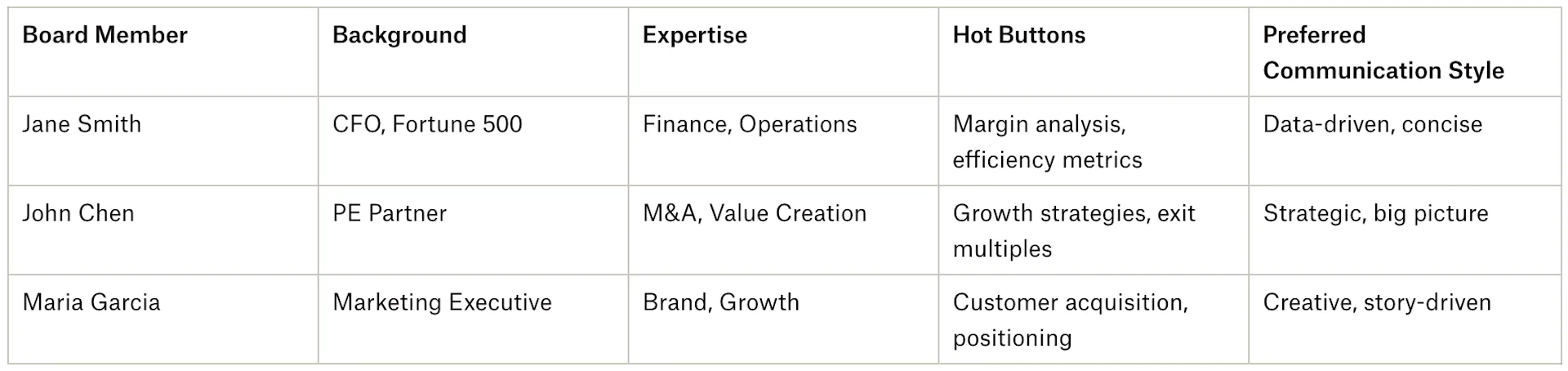
This aspect of presenting to the board is often a continuous process. While you can find out a lot about board members via their bios or LinkedIn pages, you'll also continue to learn more about them as you interact more with each person.
In 2026, consider also:
Preferences: Some board members may prefer digital-first communication; other members may want printed materials
Industry expertise: Tailor your language and examples to their background
Investment thesis: Understand why they joined your board and what they hoped to achieve
Current portfolio: For PE and VC board members, know their other commitments and how your company fits
Rehearse and be human
When there's a lot at stake with a board presentation, it's easy to stress out and end up spending the whole time reading exactly what's written on your slides. This doesn't exactly make for a compelling or engaging presentation.
Instead, it's best to spend more time rehearsing (so you can rely less on your slides) and focus on having a human conversation versus giving a one-way presentation.
Rehearsal best practices for 2026:
Record yourself: Use Zoom or Loom to record a full run-through and watch it back
Practice with your team: Run through the presentation with your executive team first
Time yourself: Ensure you hit your target timing (with buffer for questions)
Prepare for tough questions: Anticipate challenging questions and practice your responses
Test technology: If presenting remotely or hybrid, do a tech check 24 hours before
Finding the right balance:
According to research, it's about finding the right balance of preparation so that you feel confident without becoming overly stiff. You want to be prepared enough that you:
Know your content cold
Can navigate the deck without looking at it constantly
Can maintain eye contact with board members
Can handle questions smoothly
Can adapt if the conversation takes an unexpected turn
But not so over-rehearsed that you:
Sound robotic or scripted
Can't deviate from your prepared remarks
Struggle when discussions go off-script
Miss opportunities for authentic connection
Be conversational, not presentational:
Beyond that, it's important that you see the board as a group of peers—not the people holding the purse strings or a group of super-human success stories. By engaging with your audience and creating a conversation, you'll be able to encourage more collaboration and give a presentation that flows.
In practice, this means:
Making eye contact and reading the room
Pausing for questions throughout, not just at the end
Using natural language, not corporate speak
Showing vulnerability when discussing challenges
Inviting input and perspectives
Acknowledging board members' expertise
Master the art of responding to questions
In 2026, board discussions are more dynamic and interactive than ever. Gone are the days of presenting for an hour while board members sit silently. Here's how to handle the Q&A flow:
Anticipate questions:
Prepare backup slides for likely deep-dive questions
Have data ready for common follow-up inquiries
Know your numbers inside and out
Respond effectively:
Acknowledge the question: "That's
a great question about our burn rate..."
Answer directly: Don't dance around difficult questions
Provide context: Support your answer with data or examples
Know when to say "I don't know": It's better to admit uncertainty and commit to follow-up than to speculate
Offer to go deeper: "I can share more detail on that after the meeting if helpful"
For challenging questions about deal terms, valuation, or strategic pivots: Take a breath, acknowledge the concern, and provide a thoughtful, data-backed response. If you need to defer to your CFO or COO for technical details, do so confidently.
Navigate hybrid and remote presentations
With many boards now meeting in hybrid or fully remote formats, adapt your presentation style:
For remote presentations:
Look directly at the camera, not at faces on screen
Use a high-quality microphone and camera
Ensure strong lighting (front-facing, not backlit)
Share your screen smoothly and test screen-sharing in advance
Minimize distractions in your background
Mute when not speaking in large groups
Use the chat function strategically for parking lot items
For hybrid presentations:
Position yourself where you can see both in-room and remote participants
Explicitly call on remote participants to ensure they're included
Repeat questions from the room so remote attendees can hear them
Use a conference room system that provides good visibility to remote participants
Make your board presentation brilliant
Board presentations are one of the most important ways you communicate with your company's board. As such, a well-put-together and engaging presentation is one of the best tools available to you in terms of cultivating a mutually beneficial and open dialogue.
That dialogue makes it easier to solicit input on key challenges, win buy-in on new projects and strategic initiatives—including M&A opportunities, major fundraising rounds, or significant operational changes—and secure any financial needs.
Pre-meeting best practices for 2026
Send materials in advance:
Send your presentation to board members ahead of time (ideally 3-5 days before the meeting), along with your other board packet materials. In 2026, boards increasingly expect pre-reads so they can come prepared with thoughtful questions.
Dropbox DocSend makes it easy to send all of these documents securely using only a single link. Plus, with DocSend's document analytics, you can:
See who has reviewed your materials (and who hasn't)
Understand which sections received the most attention
Identify where board members spent time or had questions
Follow up individually with board members before the meeting
Gauge engagement and adjust your presentation accordingly
For M&A and private equity board presentations: Document analytics become especially valuable. You can see exactly which board members spent time reviewing deal financials, which reviewed competitive analysis, and which focused on integration risks—allowing you to tailor your presentation to their areas of focus.
Set clear expectations:
Include an agenda with timing for each section
Specify if you need board decisions or just input
Highlight any materials that require pre-reading
Note if there are any time-sensitive decisions
For financial services contexts: If presenting a term sheet, due diligence findings, or deal recommendations, clearly mark these as requiring board action and include specific approval language.
Post-meeting follow-through
Your board presentation doesn't end when the meeting does:
Immediate follow-up (within 24 hours):
Send meeting minutes or key decisions/action items
Provide any promised follow-up data or analysis
Thank board members for their input and time
Share next steps and timeline
Ongoing communication:
Update board members on progress toward approved initiatives
Flag any material changes or risks that emerge
Maintain open communication channels between meetings
Build relationships one-on-one with board members
Track and iterate:
Review your presentation performance (what
worked, what didn't)
Solicit feedback from board members
Incorporate lessons learned into your next presentation
Build a library of effective slides and approaches
Additional resources for board presentation excellence
Templates and tools:
Board presentation template (customizable for your industry)
Board meeting minutes template
Investor update template (for between scheduled board meetings)
Due diligence checklist for M&A presentations
Financial dashboard templates
For financial services professionals: If you're presenting investment opportunities, M&A deals, or portfolio company performance, consider creating standardized templates that make it easy for your board to compare opportunities and track performance consistently over time.
Security and confidentiality: For sensitive presentations involving M&A deals, fundraising terms, or strategic initiatives, use document protection features:
Password protection and authentication
NDA requirements before viewing
Email verification for access
Download restrictions
Watermarking to prevent unauthorized sharing
Time-limited access for deal presentations
By following the tips above, you'll be well on your way to giving a brilliant board presentation that showcases your performance, strengthens the relationship between the C-suite and the board, and positions your company for success—whether that's closing a major acquisition, securing your next funding round, or driving exceptional growth.
Frequently asked questions about board presentations
Q: How long should a board presentation be?
A: Aim for 30 minutes of presentation time with 30-45 minutes for Q&A and discussion. Respect your board's time and focus on high-level insights rather than minutiae.
Q: Should I send board materials in advance?
A: Yes, absolutely. Send your presentation and supporting materials 3-5 days before the meeting so board members can review and come prepared with thoughtful questions.
Q: What's the ideal number of slides for a board presentation?
A: Quality over quantity. Typically 20-30 slides for a 30-minute presentation (about 1 slide per minute), but focus on clear, visual slides rather than text-heavy content.
Q: How should I handle questions I don't know the answer to?
A: Be honest. Say "I don't know, but I'll find out and follow up with you within [specific timeframe]." Then actually follow up. Board members respect honesty and accountability.
Q: What metrics should I include for M&A board presentations?
A: Include strategic fit analysis, financial performance and projections, valuation methodology, synergy opportunities, integration timeline and costs, risk factors, and expected returns.
Q: How do I present bad news to the board?
A: Be direct and transparent. Present the facts, explain what went wrong, outline your action plan for correction, and be clear about what you need from the board to move forward.
Q: Should I present differently in hybrid or remote board meetings?
A: Yes. Ensure strong technology setup (good camera, microphone, lighting), share your screen smoothly, explicitly include remote participants, and use engagement techniques like polls or direct questions.
Ready to elevate your board presentations?
Start by sending your next board presentation through Dropbox DocSend to secure document sharing with real-time analytics. See who's reviewing your materials, what sections receive the most attention, and prepare more effectively for your board meeting.
Get started with Dropbox DocSend free for 14 days – no credit card required.