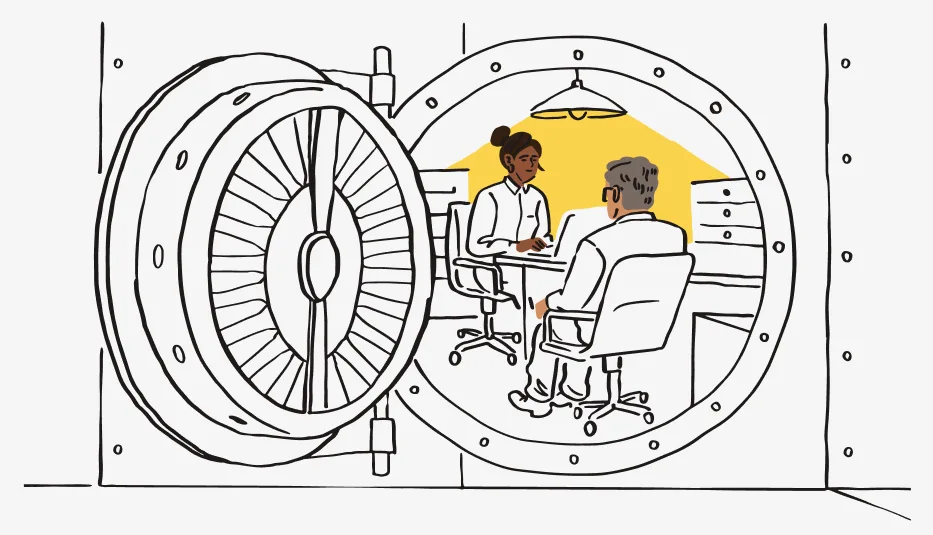
Beyond storage: Why your VDR should work like a deal intelligence platform
Legacy virtual data rooms were built to store documents — not close deals. Here's why the best deal teams are switching to VDRs that work like deal intelligence platforms, and what that shift looks like in practice.
The virtual data room has a branding problem. When most deal professionals hear the term, they picture a secure folder. A place to upload your customer contracts, your audited financials, and your intellectual property schedules so buyers can access them under controlled conditions. A necessary piece of infrastructure, but not exactly a competitive weapon.
That picture is outdated. And the deal teams that are still operating from it are leaving real money — and significant time — on the table.
The most sophisticated M&A practitioners today don't just use their VDR as a document repository. They use it as a deal intelligence platform. They read buyer behavior in real time. They use engagement data to drive their process decisions. They catch deal risk before it becomes a deal loss. And they show up to every conversation with better information than the other side has.
The difference between those two modes isn't just a matter of features. It's a fundamentally different philosophy about what a virtual data room is for.
What legacy VDRs were built to do
To understand why the intelligence gap exists, it helps to understand where virtual data rooms came from.
The first VDRs emerged in the early 2000s as digital replacements for physical data rooms — the secure, often hotel-conference-room-based environments where buyers would physically review sensitive deal documents under the supervision of the seller's advisors. The product problem being solved was access: how do you give multiple buyers secure, auditable access to sensitive materials without physically printing and managing thousands of pages of documents?
The answer was a secure web portal. Controlled logins. Permission-based access. Downloadable files with watermarking. An audit trail showing who accessed what and when. For their moment, these were genuinely impressive solutions. They made the due diligence process faster, cheaper, and more manageable for everyone involved.
But here's what they were not built for: helping you win the deal.
Legacy VDRs were engineered around the needs of the legal and compliance teams responsible for managing a secure process. They were not engineered around the needs of the deal team responsible for managing buyer relationships, maintaining competitive tension, and getting to close. Those are fundamentally different product goals — and most of the market's incumbent platforms still reflect the priorities of the first category, not the second.
The result is a generation of tools that are excellent at document governance and genuinely poor at deal intelligence. You know what you've shared. You have no idea what it means.
The cost of treating your VDR like a filing cabinet
The gap between document storage and deal intelligence isn't just a philosophical distinction — it has real, measurable consequences for how deals unfold.
Misreading buyer seriousness. Without engagement data, sellers have no reliable way to distinguish between a buyer who is genuinely deep in diligence and one who requested access to maintain optionality. Both buyers look the same in a legacy VDR: they have an active login and documents available to them. Only one of them has actually opened anything beyond the executive summary.
Reacting instead of anticipating. When you don't know which documents buyers are spending time on, you can't anticipate what questions are coming. You walk into management presentations and Q&A calls cold, without the benefit of knowing where each buyer's concerns are concentrated. That's a disadvantage you don't have to accept.
Missing the window on re-engagement. Buyers go quiet for all kinds of reasons. Some of those reasons are recoverable — an internal process hiccup, a competing priority, a deal team change. But if you don't know a buyer has gone inactive until your banker checks in a week later, you've already lost precious response time. The window to re-engage proactively is narrow, and legacy VDRs don't even show you when it opens.
Losing competitive leverage. The compression of buyer timelines in a competitive process depends on sellers having a credible read on where each bidder stands. If you can't tell your LOI deadline is credible because you have no idea which buyers are actually ready to submit, you lose the ability to manufacture urgency — one of the most powerful tools a sell-side advisor has.
These aren't edge cases. They're recurring failure modes in M&A processes that use document storage without deal intelligence. And they're entirely solvable.
What a deal intelligence platform actually does
A VDR that functions as a deal intelligence platform doesn't replace the document management capabilities of a traditional data room. It adds an intelligence layer on top of them — one that transforms every buyer interaction into actionable data for your deal team.
Here's what that looks like across the core dimensions of deal execution.
Real-time engagement analytics
Every time a buyer opens a document, spends time on a page, or returns to review something they've already seen, that behavior is captured and surfaced to your team. You're not looking at a download log after the fact — you're watching the deal unfold in real time.
This matters because deal processes don't move in neat, scheduled intervals. They move in response to buyer behavior — a spike of activity before an LOI, a sudden quiet period that signals internal hesitation, a return visit to a specific document that tells you exactly where a concern has surfaced. Intelligence-forward platforms surface these moments as they happen, so you can act on them instead of reading about them in a retrospective debrief.
Buyer-level behavioral profiling
Aggregate engagement data is useful. Buyer-level profiles are transformational. Knowing that "Buyer A" has logged in seven times this week, expanded their team access to include legal and finance, and spent concentrated time on your revenue recognition methodology tells you something you can act on: this buyer is in confirmatory mode and building toward a bid.
Knowing that "Buyer B" logged in once, spent twelve minutes mostly on the executive summary, and hasn't returned tells you something different: this buyer is likely maintaining optionality rather than running a real process.
Legacy VDRs can't make that distinction. Deal intelligence platforms make it automatically, and they make it without requiring your banker to chase down every buyer contact for a status update.
Document-level attention mapping
The most sophisticated use of VDR intelligence isn't at the buyer level — it's at the document level. Understanding which specific sections of which specific documents are drawing the most attention across your entire buyer pool is a form of deal signal that goes largely untapped in traditional processes.
If five out of seven buyers are spending concentrated time on your data privacy compliance documentation, that's a pattern with a message. Something in that section is raising questions — questions you can proactively address before they become objections in a management presentation or points of negotiation in an LOI.
Attention mapping turns your data room from a static repository into a live feedback loop on how buyers are processing the story you're telling them.
Stakeholder expansion tracking
One of the most reliable leading indicators of deal seriousness is the moment a buyer's organization starts getting broader. When someone beyond the deal lead — a CFO, a head of integration, an outside legal counsel — joins the data room for the first time, it signals that the conversation has moved from exploratory to earnest inside that buyer's organization.
Deal intelligence platforms track these access expansions in real time and surface them as discrete events. You don't have to wonder whether Buyer C has gotten organizational buy-in for the deal. You can see the moment their corporate development team starts reviewing documents alongside their M&A integration lead.
Permissioned access management at scale
Running a competitive process with ten buyers in your room requires granular, buyer-specific access controls — not just a uniform permission set for everyone. Some buyers need access to certain financial schedules. Others can see customer contracts only after signing enhanced NDA terms. Still others are in a different stage of the process and should only have access to Phase 1 materials.
Intelligence-forward platforms manage this complexity without friction, letting your team configure and update permissions at the buyer level without disrupting the broader process. And when a buyer elevates to a more advanced stage, expanding their access is a controlled action — not an administrative scramble.
How deal teams are using intelligence to change outcomes
The shift from storage to intelligence isn't theoretical. It's playing out across M&A processes right now, and the teams using it are getting concrete advantages.
Smarter process management. Deal teams that can see engagement levels across their buyer pool in real time can make better decisions about process timing — when to push for LOIs, when to extend a deadline, when to create competitive urgency. That kind of data-driven process management produces tighter bid rounds and stronger economics.
Better management preparation. When sellers can see which documents buyers are scrutinizing before management presentations, they can tailor their prep accordingly — walking in ready to address the specific concerns that the data has already surfaced. That's a different quality of preparation than walking in cold.
Faster identification of deal risk. Engagement gaps — buyers who have gone silent during active diligence — surface quickly in an intelligence platform, giving deal teams time to intervene. In a legacy VDR, those gaps often don't become visible until the buyer formally withdraws. By then, it's too late.
More credible advisor relationships. For investment bankers and M&A advisors, real-time VDR intelligence adds a layer of credibility to every client interaction. When your banker can tell you exactly which buyers are most engaged, which documents are getting attention, and where the process risk is concentrated, those conversations feel fundamentally different from a banker reading off their call notes.
Why DocSend was built for this moment
DocSend's VDR was designed from the ground up as a deal intelligence platform — not a document storage system with analytics bolted on afterward. That design philosophy shows up in how the product actually works.
Engagement data is native, not optional. Every document interaction is tracked and surfaced through purpose-built analytics dashboards that your deal team can actually use, without needing to be data analysts. The insights are directional and immediate: who's engaged, what they're looking at, and what the patterns are telling you.
The access management layer is built for the complexity of real M&A processes — competitive bidder pools, staged document releases, buyer-specific permissions, and Q&A workflows that keep the deal moving without creating administrative chaos. And because DocSend is built for deal professionals rather than general enterprise users, the interface reflects the actual workflow of a sell-side process rather than forcing deal teams to adapt to a generic content management paradigm.
The result is a data room that functions less like a filing cabinet and more like a command center — giving your deal team the visibility to make faster, better-informed decisions at every stage of the process.
The stakes have changed — your VDR should too
The M&A market has changed. Processes are faster, buyer pools are more sophisticated, and the cost of misreading a process — or letting deal risk go undetected until it's too late — is higher than it's ever been.
The virtual data room category has to change with it. Document storage was the right answer for 2005. Deal intelligence is the right answer for now.
The deals that get done efficiently, at strong valuations, with minimal late-stage surprises are increasingly the ones where sellers had better information than their counterparts expected. Not because they were luckier or had better assets — but because they were reading the room.
Your VDR can be the tool that gives you that edge. But only if you're asking it to do more than hold your files.
Ready to move beyond storage? Explore DocSend VDR and see what a deal intelligence platform looks like in practice with 2 weeks free.
Informazioni sull'autore