Categories
Startup Resources

Sealing the deal in 12 slides: What VCs really want to see inside your seed deck

In this blog, we dismantle the science behind building a successful pre-seed pitch deck and the make-or-break sections that go inside.
Justin Izzo headshot
Justin IzzoResearch Lead, Dropbox DocSend
March 10, 2026
What VCs really want to see inside your seed deck

Updated March 10, 2026

Originally published May 3, 2022

If you’re a seed founder ready to get potential investors amped about your product, look no further than your pitch deck. Building a simple, well-thought-out deck will not only help you capture VC attention quickly, but will also convince them why your company is positioned to be the next big thing.

In this guide, we explain what a successful seed pitch deck looks like, how long VCs spend on each section, and the specific information investors want to see inside.

What is the purpose of a seed pitch deck?

Founders use seed decks to educate and excite potential investors about their product and market potential—ultimately using it as a tool to raise money. But in 2026, your deck needs to do more than generate excitement. It needs to demonstrate capital efficiency, show a clear path to profitability, and prove you understand the disciplined approach required to build sustainable companies in today's environment.

Structurally, seed founders organize their decks in a way that tells a compelling narrative VCs can quickly understand. The best decks balance ambitious vision with realistic execution plans, showing both what's possible and how you'll actually get there.

How much time do investors spend reviewing seed decks?

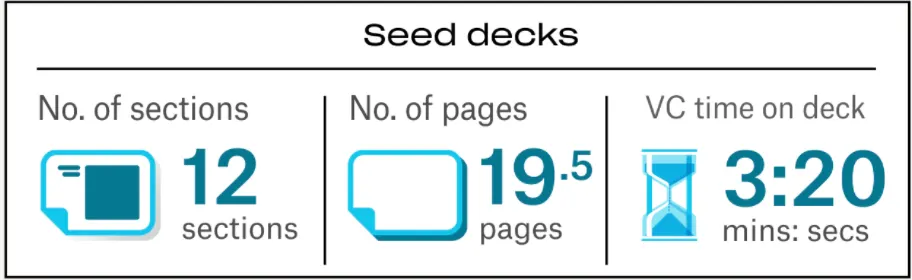
We see VCs spend an average of three minutes and 44 seconds reviewing seed pitch decks. With less than four minutes to hook their interest, this means that seed founders need to get their attention at the very beginning of the deck to get them to continue all the way through.

Here's the reality: only 58% of pitch decks are viewed to completion. This means nearly half of founders lose investor attention before reaching their final slides. The implication is clear—every slide must earn the right to the next slide's attention.

What does a successful seed pitch deck look like in 2026?

While all successful pitch decks are unique, each follows a proven structure designed to capture VC attention quickly. In 2026, the most effective decks share these characteristics:

  • Clarity over cleverness: Straightforward language beats creative wordplay

  • Data-driven storytelling: Claims backed by evidence, not aspirations

  • AI transparency: Specific about how AI creates value, not just "AI-powered"

  • Capital efficiency focus: Demonstrating thoughtful resource allocation

  • Realistic projections: Conservative growth models beat hockey-stick fantasies

  • Sustainability awareness: Environmental and social impact considerations where relevant

Following clear formatting, content, and slide order guidelines lets founders tell a compelling story that captures VC interest in today's more selective funding environment.

What sections need to be included in a seed pitch deck?

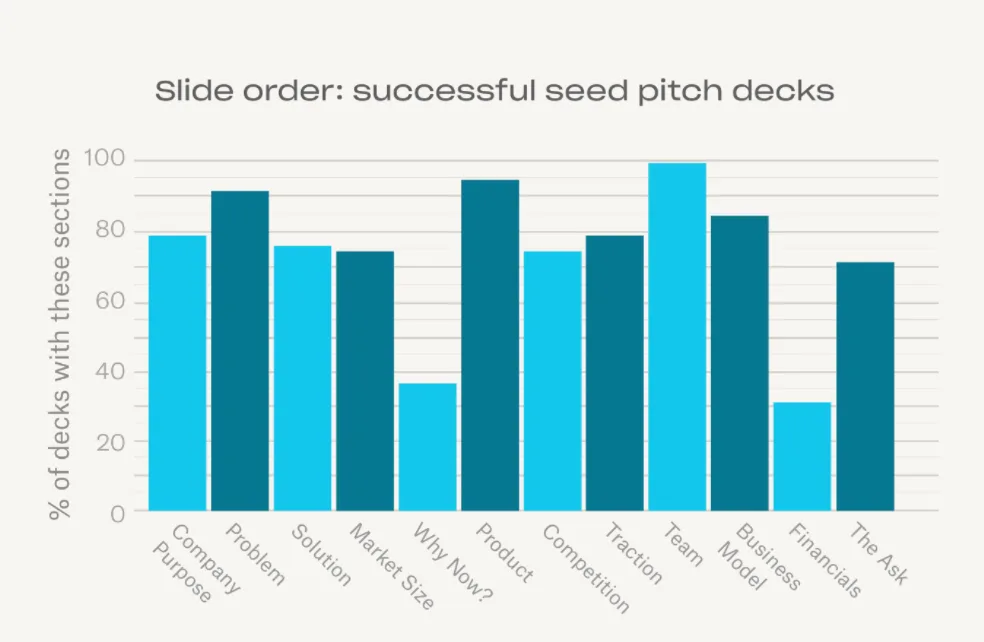
We’ve found that building a 19-20 page deck with the following sections is the best way to catch the attention of busy investors:

  1. Company purpose

  2. Problem

  3. Solution

  4. Market size

  5. Why now? (optional but increasingly important)

  6. Product

  7. Competition

  8. Traction

  9. Team

  10. Business model

  11. Financials (optional but recommended)

  12. Fundraising ask

sealing-deal-2-.png

Keep in mind that your slide order matters significantly. Founders who open their decks with the first four sections above are more likely to raise funding than those who opt for other approaches. This isn't arbitrary—it mirrors how investors think about evaluating opportunities.

Below, we break down each section, explain their purposes, and share do's and don'ts informed by what's working in today's market.

Section 1: Company purpose

This is the first slide in your seed deck and should clearly outline your company's purpose in a single sentence. In 2026, with AI tools making it easier than ever to generate polished copy, authenticity and clarity matter more than ever.

Do: Test your purpose statement with people outside your bubble. What words capture their interest most? Equally important, does it make immediate sense? Your purpose statement should be both enticing and instantly understandable. If someone needs to read it twice, you haven't nailed it yet.

Don't: Overcomplicate it or hide behind buzzwords. Saying you're "leveraging AI to revolutionize the future of work" tells investors nothing. Busy VCs have neither the time nor patience to decipher vague vision statements. Keep your company purpose simple, specific, and memorable.

2026 tip: If your company involves AI, be specific about what the AI actually does. "We use AI to automatically extract financial data from unstructured documents, reducing accounting time by 90%" is infinitely more compelling than "We're an AI-powered fintech platform."

Target section length:1 page

Industry averages:

  • Average length: 1.3 pages

  • Time VCs spend here: 26 seconds

Section 2: Problem

The problem section immediately follows your company's purpose. This slide broadly addresses the one problem your company is solving—and in 2026, it needs to prove this problem is both real and urgent.

Do: Make it relatable to people in and outside of your industry. As a rule of thumb: if your friends or family can't understand the problem you're solving, chances are an investor won't either. Use concrete examples, real customer quotes, or data that proves the pain point exists and matters.

Don't: Overcomplicate it or pitch a problem that doesn't actually exist at scale. In today's market, investors have seen too many solutions looking for problems. Define the problem using simple, easy-to-understand language that anyone can follow. If an investor can't immediately grasp the problem, they won't see the value of investing in your solution.

2026 tip: Connect your problem to current market forces where possible. Is this pain point getting worse because of remote work? New regulations? AI disruption? Supply chain complexity? Showing how 2026 conditions are making this problem more acute demonstrates market timing.

Target section length:1-2 pages

Industry averages:

  • Average length: 2.15 pages

  • Time VCs spend here: 34 seconds

Section 3: Solution

Think of the solution section as the companion slide for your problem statement. Clearly and broadly outline how you're solving the previously defined problem—and why your approach is differentiated.

Do: Articulate why your solution is unlike any other on the market. In a world where AI tools have lowered barriers to building software, explain why your strategy is both creative and defensible. Investors want to know why your product or service is different and harder to replicate than it appears.

Don't: Dive into technical specifics here—you'll go deeper into your product later on. Stay aligned to the problem with a clear, easy-to-understand solution statement. Avoid the temptation to lead with technology before explaining the value it creates.

2026 tip: If you're using AI, explain your unique data advantage, proprietary models, or specialized fine-tuning rather than just mentioning you use GPT or Claude. If you're solving a problem that AI could theoretically automate, address why human oversight, judgment, or workflow integration makes your approach superior.

Target section length: 1-2 pages

Industry averages:

  • Average length: 1.5 pages

  • Time VCs spend here: 34 seconds

Section 4: Market size

As the fourth section in a seed deck, your market size slides should define your target customer with a comprehensive market analysis. In 2026, investors are more skeptical of inflated TAM claims—show them realistic, defensible numbers.

Do: Make this section robust by sharing TAM SAM SOM market research from credible sources. VCs care about both short and long term opportunities. Show them where they can get a return on their investment within the first couple of years, as well as a sense of their long-term growth potential. Be specific about your beachhead market—the precise customer segment you're targeting first.

Don't: Forget to connect this section back to your first three sections. Your purpose, problem, solution, and market size sections should tell a cohesive, compelling story that entices investors to keep reading. And don't claim absurdly large markets without explaining your realistic path to capturing meaningful share.

2026 tip:If you're in a market being transformed by AI, show both the current market size and how AI is expanding it. For example, "legal document review is a $10B market, but AI-augmented review could expand this to $25B by addressing work previously too expensive to outsource."

Target section length:1-3 pages

Industry averages:

  • Average length: 1.7 pages

  • Time VCs spend here: 29 seconds

Section 5: Why now?

While optional, this section has become increasingly important in 2026's market. It gives you an opportunity to highlight why this specific moment creates urgency for your problem and solution.

Do: Consider what market conditions make your company possible or necessary right now. Is there new enabling technology? Regulatory change? Behavioral shifts? Economic pressures? The most compelling examples in 2026 include AI capability breakthroughs, sustainability compliance requirements, hybrid work complexities, data privacy regulations, and generational workforce transitions.

Don't: Stress about including this slide if your problem isn't connected to any particular timeliness—but recognize that in today's market, demonstrating timing often strengthens your case. Investors are particularly interested in companies riding clear secular trends rather than fighting uphill battles.

2026 tip: If your company wouldn't have been possible or viable even 2-3 years ago, make that explicit. New AI capabilities, recently available data sets, fresh regulatory frameworks, or changed consumer behaviors can all create powerful timing narratives.

Target section length: 1 page

Industry averages:

  • Average length: 1.5 pages

  • Time VCs spend here: 23 seconds

Section 6: Product

The product section highlights the unique features you've built to solve the business problem. In 2026, investors expect to see working products, not sketches and promises.

Do: Deep dive into product readiness here. In three to five slides, explain your most important product features using screenshots, embedded demo videos, interactive prototypes, or Figma mockups. Show the actual user experience, not just describe it. If you can include a QR code or link to a live demo, even better.

Don't: Underestimate how important this section is to potential investors. The product section will be one of the most scrutinized parts of your deck. In today's market where building MVPs is faster than ever, investors expect to see tangible progress. Use this opportunity to show VCs exactly what the product experience looks like and what makes it special.

2026 tip: If your product includes AI features, show them in action with real examples. Screen recordings demonstrating your AI's outputs, speed, or accuracy are far more convincing than bullet points claiming superiority. Investors have AI fatigue from generic claims—show, don't tell.

Target section length:3 -5 pages

Industry averages:

  • Average length: 3.3 pages

  • Time VCs spend here: 59 seconds

Section 7: Competition

The competition section should clearly outline who you're competing against and why your product is different. In 2026, investors can quickly research your competitors themselves, so honesty trumps spin.

Do: Focus on companies and products that compete closely with yours. Include companies at similar stages or those who've successfully raised money recently. Comparison matrices with clear dimensions work well—but make sure you're comparing on factors customers actually care about, not just areas where you look best.

Don't: Claim you have no competitors or only compare yourself to massive incumbents. Show VCs who's really competing for your customers today and articulate how you solve the problem in a way others can't. If you're in a new category, explain what alternatives customers currently use.

2026 tip: With AI tools democratizing software development, competition is fiercer than ever. Address how you're building defensibility—whether through unique data, specialized expertise, network effects, or go-to-market advantages. Naive "we'll just build it better" positioning won't cut it anymore.

Target section length:1 page

Industry averages:

  • Average length: 1.3 pages

  • Time VCs spend here: 34 seconds

Section 8: Traction

This section should detail notable traction based on the stage of your product. Traction can include current customers, user growth, revenue, engagement metrics, testimonials, and validation signals.

Do: Indicate multiple types of market traction. We found that VCs spend 80% more time evaluating the traction of companies that didn't successfully raise money. If your market traction isn't immediately obvious to investors, it may raise skepticism and prompt scrutiny that may not work in your favor. Show momentum through growth trends, not just absolute numbers.

Don't: Fret about not having enough to show. Investors will account for your product's stage. You can include letters of intent, design partner commitments, beta user feedback, waitlist signups, or early revenue as appropriate. But whatever you show, make it demonstrate genuine customer demand, not just polite interest.

2026 tip: In today's capital-efficient environment, investors particularly value metrics that show product-market fit: strong retention rates, low customer acquisition costs, high engagement, organic growth, or rapid sales cycles. One paying customer with great retention beats 100 tire-kickers.

Target section length: 1-4 pages

Industry averages:

  • Average length: 2.3 pages

  • Time VCs spend here: 40 seconds

Section 9: Team

The team section introduces your founding team members and describes why they're the right people to solve this problem. In 2026, with remote work enabling access to global talent, investors are evaluating teams differently than before.

Do: Explain why these specific people are uniquely positioned to solve this problem. Showcase backgrounds and skillsets using LinkedIn profile pictures, concise bios, and relevant work experience. Highlight domain expertise, previous startup success, complementary skills, and unique insights. Remember: VCs invest in people as much as ideas, and exceptional teams can navigate inevitable pivots.

Don't: Make this section more than two pages. It'll naturally be one of your most detailed sections, so be ruthlessly selective about what you include. Focus on experience and capabilities directly relevant to your company's challenges.

2026 tip: Address your team's approach to distributed work if you're not co-located. Investors understand remote-first operations but want confidence you can execute effectively. If you have proven track records building remotely, highlight that. If you have unique advantages from geographic distribution (24/7 development, global market access, diverse perspectives), make that clear.

Target section length: 1-2 pages

Industry averages:

  • Average length: 1.5 pages

  • Time VCs spend here: 38 seconds

Section 10: Business model

The business model section outlines a clear, understandable monetization strategy that's repeatable and scalable over time. This section has become increasingly critical as 2026's investors prioritize path to profitability over pure growth.

Do: Show investors you're building a sustainable, fully-fledged business. This section gets the longest look from VCs, so explain precisely how you'll make money and what makes your business model economically attractive. Include unit economics if you have them—gross margins, customer lifetime value, payback periods, and customer acquisition costs.

Don't: Leave this as an afterthought or assume you'll "figure out monetization later." In today's market, that approach gets you passed over immediately. Develop your business model and monetization plans in tandem with your product strategy to keep them tightly aligned from the beginning. Investors want to back companies that can reach profitability without requiring endless funding rounds.

2026 tip: Be realistic about what customers will pay. The "growth first, monetize later" playbook died years ago. Show you've validated pricing with real customers or comparable products. If you're freemium, explain conversion rates. If you're enterprise, show sales cycle data. Investors appreciate honest, conservative models over hockey-stick optimism.

Target section length:2-3 pages

Industry averages:

  • Average length: 2.8 pages

  • Time VCs spend here: 64 seconds

Section 11: Financials

While still optional, financial transparency has become increasingly expected in 2026's environment. This section explains your strategic spending history, burn rate, and runway.

Do: Include this slide, especially if you can show how previous spending fueled positive returns. If you've achieved product milestones, customer traction, or revenue growth on limited capital, highlight that efficiency. In today's market, capital discipline is a feature, not a bug. This section had the sixth-longest viewing time among decks that included it—investors care about how you manage money.

Don't: Skip this section without considering its importance. Answer these questions: How have you deployed previous funding? What resources did you prioritize? How did those investments contribute to measurable outcomes? If you've bootstrapped to validation, that's a powerful signal. If you've raised before, show what you accomplished with that capital.

2026 tip: Investors are allergic to excessive burn rates. If you're spending $200K/month but only have $50K in revenue, you need a compelling story about why that burn is necessary and how it will decrease as you scale. Companies demonstrating path to break-even or already approaching profitability have significant advantages in today's market.

Target section length:1-2 pages

Industry averages:

  • Average length: 1.4 pages

  • Time VCs spend here: 37 seconds

Section 12: Fundraising ask

The fundraising ask is the final section in your deck and tells investors how much you want to raise and how you plan to spend it. In 2026, specificity and strategic thinking matter more than ever.

Do: Thoughtfully explain how you'll deploy the capital. Will you hire key team members? Invest in product development? Scale marketing? Each dollar should tie to specific milestones and outcomes. You're defining the next chapter for your company, and your fundraising ask should reflect a mature understanding of what it takes to reach your next inflection point.

Don't: Pick an arbitrary number or present a vague allocation. State exactly how much you need, defend why that amount gets you to meaningful milestones, and be ready to discuss how you'd adjust plans with more or less capital. Investors appreciate founders who've thought through different scenarios.

2026 tip: In today's market, showing 18-24 months of runway is standard. Explain what milestones you'll hit that position you for a successful Series A. If you're raising less than needed to reach those milestones, address your plan for extending runway through revenue or interim financing. Transparency about runway and next steps builds confidence.

Target section length: 1 page

Industry averages:

  • Average length: 1.2 pages

  • Time VCs spend here: 32 seconds

Your Deck is Your Foundation, Not Your Finish Line

Remember that your pitch deck is a tool, not the destination. The best deck in the world won't save a fundamentally flawed business, and a mediocre deck won't kill a great opportunity if you can get in front of the right investors.

View your deck as the start of a conversation, not the end. It should generate interest, prompt questions, and open doors to deeper discussions. Once you're in the meeting—whether over Zoom or in person—your ability to answer questions, demonstrate depth, handle objections, and build relationships becomes far more important than any slide.

The companies raising strong seed rounds in 2026 combine compelling visions with tangible execution, bold ambitions with realistic plans, and authentic confidence with intellectual honesty about challenges ahead. Build a deck that reflects these qualities, focus on creating genuine customer value, and demonstrate the traction that proves you're onto something real.

If you do that well, the right investors will lean in, engage deeply, and ultimately provide the capital you need to build something meaningful.

Leave a Lasting Impression

Getting attention from potential investors has never been harder than it is in 2026, which is why creating a winning pitch deck is table stakes for seed founders. By building a thoughtful, well-structured pitch deck that demonstrates both vision and execution, you can show investors the time, research, and strategic thinking you've invested in building a successful company—and why your idea and business is one they'll want to back.

The best pitch decks don't just inform—they inspire. They make investors lean forward in their chairs, ask thoughtful questions, and imagine the future you're building. That's the standard you're aiming for.

About the Author

Justin Izzo headshot

Justin Izzo

Research Lead, Dropbox DocSendJustin Izzo is Research Lead, DocSend at Dropbox. He joined DocSend in 2020 to run startup and venture capital fundraising research. Previously, Justin was a Professor at Brown University and Duke University. He also received his Ph.D. from Duke University.
Experience the best of DocSend free for 14 days
Securely share your documents with real-time control and insights—no matter where you're working.Get Started Free
No credit card required

Subscribe to The Weekly Index for exclusive content