What is a VDR? All you need to know
Here’s everything you need to know about VDRs—secure online platforms for sharing and managing sensitive files in one centralized location.

Updated March 26, 2026
Originally published September 11, 2024
Virtual data rooms (VDRs) have become the backbone of secure business collaboration in 2026. Whether you're closing a merger, raising capital, or managing sensitive board communications, understanding VDRs is essential for modern business operations.
Here's your comprehensive guide to virtual data rooms—secure online platforms that centralize file sharing, protect confidential information, and streamline critical business processes.
Understanding virtual data rooms: the basics
A virtual data room is a secure online repository where businesses store, share, and collaborate on sensitive documents with internal teams and external stakeholders. Unlike traditional file sharing methods or email attachments, VDRs provide enterprise-grade security, granular access controls, and detailed analytics to track document activity in real-time.
Think of a VDR as a digital fortress for your most important files—one that combines bank-level security with the convenience of cloud access from anywhere, at any time.
Why VDRs matter more than ever in 2026
The business landscape has evolved dramatically. Remote work, global collaboration, and increasingly sophisticated cyber threats have made traditional document sharing methods obsolete. Here's why VDRs have become indispensable:
Enhanced Security: Email and basic file sharing expose your sensitive data to significant risks. VDRs use military-grade encryption, multi-factor authentication, and advanced access controls to safeguard your most confidential information.
Complete Control: Never wonder who's accessing your files again. VDRs give you granular control over every document, letting you approve or deny specific actions like viewing, editing, downloading, or sharing.
Business Intelligence: Modern VDRs like Dropbox DocSend provide real-time analytics that show exactly how stakeholders engage with your documents—transforming document sharing into a strategic advantage.
Compliance Confidence: With regulations like GDPR, CCPA, SOC 2, and industry-specific requirements becoming more stringent, VDRs help you meet compliance standards automatically.
6 essential features of modern VDRs
Today's virtual data rooms go far beyond simple file storage. Here are the game-changing capabilities that define cutting-edge VDR platforms like DocSend.
1. Bank-level security & encryption
Security isn't optional—it's everything. Modern VDRs employ multiple layers of protection:
End-to-end encryption: Your files are encrypted both in transit and at rest
Multi-factor authentication: Adds an extra security layer beyond passwords
Detailed audit trails: Automatic tracking of every action taken on every document
Version control: Maintain a complete history of document changes with the ability to revert if needed
DocSend VDRs take security further with approval workflows that let you control not just who accesses files, but what actions they can perform on them.
2. Granular access controls & user permissions
Not everyone needs access to everything. Advanced VDRs let you set precise permissions:
Role-based access: Assign permissions based on user roles, departments, or responsibilities
Group permissions: Manage access for entire teams with a single action
Expiring links: Set time limits on document access for enhanced security
Dynamic watermarking: Embed unique identifiers into documents to track leaks and discourage unauthorized sharing
This level of control is essential when working with external parties like investors, potential acquirers, or third-party advisors.
3. Real-time document analytics & intelligence
Transform document sharing from a blind process into a strategic tool. Advanced analytics reveal:
View counts and duration: See exactly how long each person spends on each page
Download and share tracking: Know when files leave your VDR
Real-time notifications: Get instant alerts when important documents are accessed
Engagement heatmaps: Identify which sections receive the most attention
User behavior patterns: Understand how different stakeholders interact with your content
These insights are invaluable for fundraising, sales processes, and due diligence—helping you follow up at exactly the right moment with exactly the right message.
4. Integrated eSignatures
Speed matters in business. VDR-integrated eSignatures eliminate the printing, scanning, and mailing that slow down critical transactions:
Legally binding signatures: Meet legal requirements across jurisdictions
One-click signing: Streamline the execution process for all parties
Audit trails: Maintain complete records of who signed what and when
Mobile compatibility: Enable signatures from any device
DocSend's eSignature features are particularly valuable in industries like M&A, legal, and financial services where compliance requirements are strict and delays are costly.
5. Seamless collaboration tools
VDRs aren't just about security—they're about working better together:
Commenting and annotations: Enable discussions directly within documents
Task assignments: Delegate review responsibilities and track completion
Version synchronization: Ensure everyone works from the latest version
Integration capabilities: Connect with tools like Salesforce, Slack, and other business platforms
Types of VDRs: use cases across industries
Virtual data rooms serve diverse business needs across multiple sectors. Here's how different industries leverage VDR technology:
Startups and growth companies use VDRs to share pitch decks, financial models, and due diligence materials with potential investors:
Pitch deck distribution: Track which slides investors spend the most time on
Due diligence management: Organize and share financial statements, contracts, and legal documents
Investor communications: Maintain a secure channel for questions and updates
Competitive insights: Understand which investors are most engaged before you prioritize follow-ups
Mergers & acquisitions (M&A)
VDRs streamline the complex due diligence process that defines M&A transactions:
Document organization: Structure thousands of files into a logical, searchable repository
Secure access for multiple parties: Manage access for buyers, sellers, advisors, and legal teams
Q&A management: Track questions and responses in one centralized location
Deal tracking: Monitor document access to gauge buyer interest and deal momentum
Board communications & corporate governance
Public and private companies use VDRs to enhance board effectiveness:
Board packet distribution: Share meeting materials securely before meetings
Minutes and resolutions: Maintain a complete, organized record of board activities
Committee management: Provide secure access to committee-specific documents
Voting and approvals: Facilitate remote board actions with eSignatures
Compliance & regulatory reporting
Heavily regulated industries depend on VDRs for audit readiness:
Regulatory document management: Organize compliance documents for easy retrieval
Audit preparation: Provide auditors with secure, controlled access to necessary files
Retention compliance: Maintain documents according to industry-specific requirements
Privacy compliance: Meet GDPR, CCPA, and other data protection regulations
Legal & intellectual property
Law firms and legal departments leverage VDRs for:
Litigation management: Organize case files and discovery documents
Contract management: Store and track agreements with version control
IP protection: Secure patents, trademarks, and proprietary information
Client communications: Share sensitive legal documents securely
Real estate & construction
Property transactions require extensive documentation and multiple stakeholder coordination:
Property due diligence: Share leases, inspection reports, and financial data
Project documentation: Manage construction plans, permits, and contracts
Transaction management: Coordinate between buyers, sellers, lenders, and legal teams
Portfolio management: Organize documents across multiple properties
Virtual data room costs: what to expect in 2026
VDR pricing varies based on several factors. Understanding these components helps you budget effectively:
Pricing models
Per-User Pricing: Monthly fees based on the number of active users. This model works well for teams with predictable, stable user counts. Typical range: $50-$200 per user per month.
Storage-Based Pricing: Costs scale with the volume of data stored. Best for organizations with variable user counts but consistent storage needs. Typical range: $500-$5,000+ per month depending on storage tiers.
Per-Page Pricing: Some providers charge based on pages uploaded or accessed. This older model is becoming less common but may offer value for specific use cases.
Flat-Rate Plans: Fixed monthly or annual fees covering unlimited users and reasonable storage. Ideal for growing teams that want predictable costs.
Additional cost considerations
Implementation and Setup: Expect $1,000-$10,000 for enterprise implementations requiring custom configuration, API integrations, or data migration. However, intuitive platforms like DocSend minimize these costs with easy setup.
Training: While traditional VDRs may require extensive training sessions, modern platforms prioritize user-friendly interfaces that reduce or eliminate training costs.
Support and Maintenance: Ongoing technical support may incur additional fees, though many providers include basic support in monthly subscriptions. Premium support packages typically range from $200-$2,000+ per month.
Customization and Integration: Custom features, white-labeling, or advanced integrations can add $5,000-$50,000+ depending on complexity.
Cost optimization strategies
Choose flexible, scalable plans: Select providers that let you adjust as your needs change
Prioritize user-friendly platforms: Reduce training costs by choosing intuitive interfaces
Leverage free trials: Test platforms before committing to ensure they meet your needs
Consider all-in-one solutions: Platforms that bundle analytics, eSignatures, and watermarking provide better value than cobbling together separate tools
DocSend offers transparent, flexible pricing plans designed for businesses of all sizes, from startups to enterprises.
Is a VDR right for your organization?
Determining whether you need a VDR depends on several factors:
You definitely need a VDR if:
Security is Critical: If you handle confidential financial data, proprietary information, personal data, or intellectual property, a VDR is essential. Email and basic file sharing simply can't protect your most sensitive assets.
You Manage Large Document Volumes: Organizations dealing with hundreds or thousands of documents need VDR organizational capabilities to maintain order and accessibility.
You're in a Regulated Industry: Finance, healthcare, legal, and other sectors with strict compliance requirements benefit enormously from VDR audit trails and security features.
External Collaboration is Frequent: If you regularly share documents with investors, clients, partners, or advisors, VDRs provide secure, controlled access that protects your interests.
Document Intelligence Matters: If understanding how stakeholders engage with your content gives you a competitive advantage—in fundraising, sales, or negotiations—VDR analytics are invaluable.
You might not need a VDR if:
You primarily share non-sensitive, public information
Your document volumes are minimal (fewer than 100 files)
You have no external collaboration requirements
Your industry has no compliance or security requirements
You have no need to track document engagement
Start with a free trial
Not sure if a VDR is right for you? DocSend offers a risk-free trial that lets you experience advanced VDR capabilities firsthand—no credit card required. Get in touch to explore how a VDR can transform your document workflows.
VDR vs. traditional file sharing: key differences
Understanding how VDRs compare to alternatives helps clarify their value:
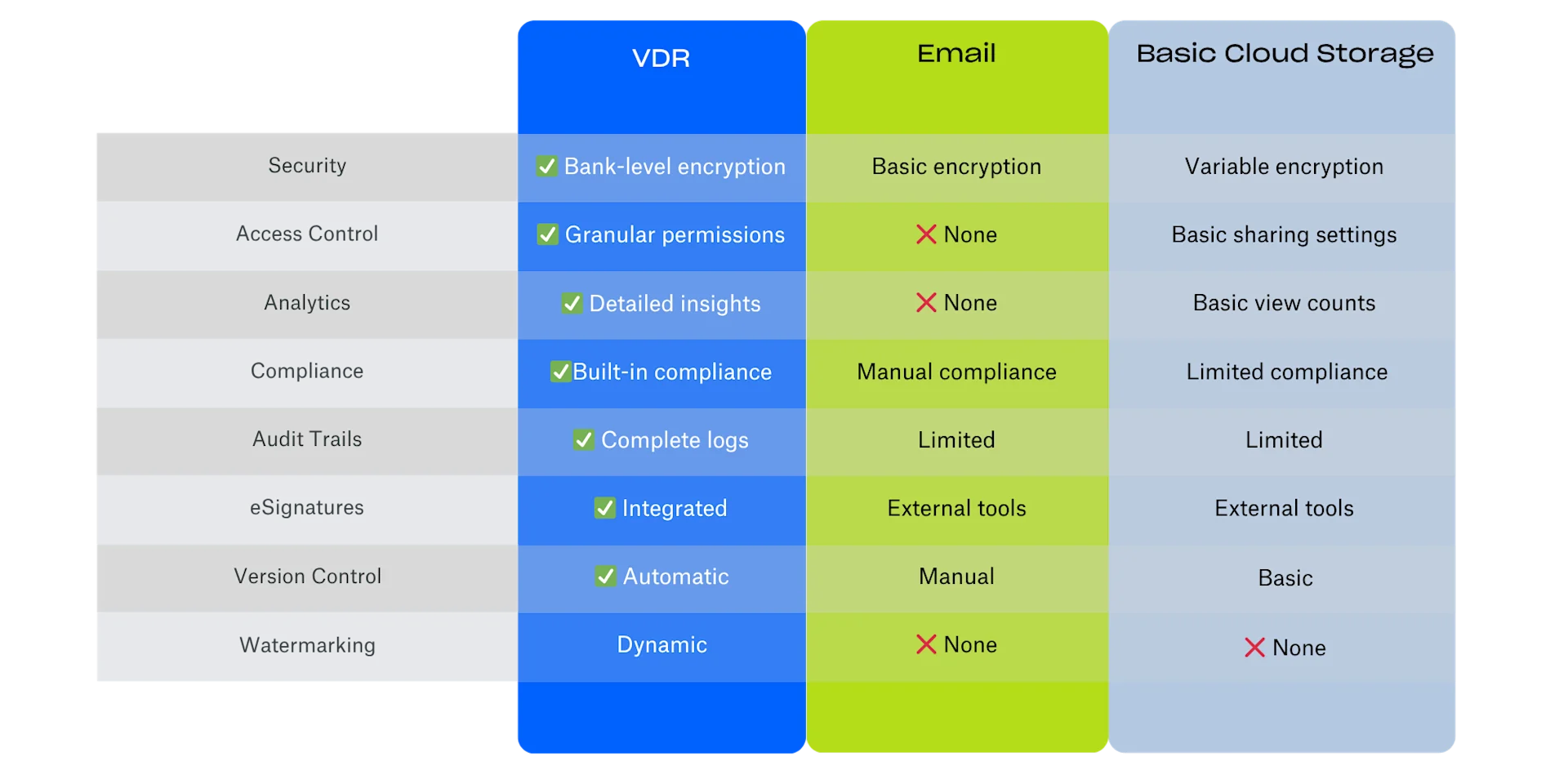
The difference is clear: VDRs provide comprehensive solutions that basic tools can't match.
Frequently asked questions about VDRs
What does VDR stand for?
VDR stands for virtual data room.
What are other names for a VDR?
Virtual data rooms are also called virtual deal rooms, secure data rooms, electronic data rooms (EDRs), or secure document sharing platforms.
Why are VDRs important?
VDRs are essential because they provide the only truly secure and efficient way to share sensitive documents while maintaining complete control and visibility. They protect your data while enabling the collaboration that modern business requires.
How secure are VDRs compared to email?
VDRs are vastly more secure than email. They employ end-to-end encryption, granular access controls, multi-factor authentication, dynamic watermarking, and complete audit trails—security measures that email simply cannot provide.
What industries benefit most from VDRs?
While any organization handling sensitive information can benefit, VDRs are particularly valuable in finance, legal, healthcare, life sciences, real estate, technology, investment management, private equity, venture capital, and professional services.
How long does it take to implement a VDR?
Implementation time varies by platform and complexity. User-friendly solutions like DocSend can be operational in hours, while complex enterprise implementations might take weeks. The key is choosing a platform with intuitive setup.
Are VDRs suitable for small businesses?
Absolutely. VDRs benefit businesses of all sizes. Small companies, startups, and mid-market firms often have the most to lose from a security breach, making VDR protection especially valuable. Modern VDR pricing includes plans designed specifically for smaller organizations.
Can I customize the look and feel of my VDR?
Many VDRs offer white-labeling and customization options, allowing you to maintain your brand identity even when sharing externally.
The future of virtual data rooms
As we progress through 2026, VDRs continue to evolve with emerging technologies:
AI-powered insights: Machine learning analyzes document engagement to predict deal outcomes and recommend next steps
Enhanced automation: Automated workflows streamline repetitive tasks and approval processes
Advanced security: Behavioral analytics and threat detection prevent unauthorized access before it happens
Improved collaboration: Real-time co-editing and video conferencing integration blur the lines between communication and document management
Blockchain integration: Immutable audit trails provide even greater security and compliance assurance
Get started with DocSend VDR
DocSend provides cutting-edge VDR capabilities designed for modern businesses. Our platform combines enterprise-grade security with an intuitive interface that requires no training.
With features including:
Advanced analytics and real-time notifications
Integrated eSignatures for fast deal execution
Dynamic watermarking for enhanced protection
Flexible pricing for every organization size
Seamless integrations with your existing tools
Mobile access for work anywhere, anytime
Experience the DocSend difference with a free trial—no credit card required. Join thousands of companies that trust DocSend to protect their most important documents while accelerating their most critical business processes.
Ready to take control of your document security and gain valuable business intelligence? Try DocSend for free today.
About the Author